
Burnout in the Age of 996: A Bay Area Therapist on Silicon Valley’s New Survival Mode
Silicon Valley Burnout, 996 Culture, and AI Stress: What a Bay Area Therapist Is Seeing in 2025
Burnout and hustle are back in style in Silicon Valley. As a therapist, I don’t think I’ve ever felt a cultural shift happen this fast inside my therapy office.
One minute, the San Francisco Bay Area was talking about burnout prevention, psychological safety, flexible work, well-being, and “quiet quitting.” I genuinely thought the pandemic ushered in care for workers. I even had friends announcing new burnout coaching offerings like it was the next yoga teacher training. And then-almost overnight-the vibe changed.
The grind is back. But it is eerily different, and I feel a kind of gut punch about it. The hustle is not the manic, excited startup-hardcore grind of the dot‑com boom or early 2010s. This feels hollow, almost zombie-like to me. There is a lot of fear and survival energy with it.
Most people aren’t coming into my office fantasizing about quitting, or reinventing their lives, or running off to do ayahuasca in Costa Rica like a few years ago.
They’re saying:
"I just need to make it through another day. Help."
I think partly because I came up in tech, I attract a lot of startup founders, VCs, execs, tech people, and everyday Bay Area folks who simply live inside the gravitational field of the tech industry. If you ever visit San Francisco, it is almost a one-industry town where the vibes of what is going on inside Google, Meta, and Salesforce.com leak out to everyone, and even on playgrounds. But I have never seen a psychological trend turn this quickly. The pendulum didn’t swing. It snapped.
What Changed? Silicon Valley 996 Burnout Culture Is Back (And Different)
996-working, 9 a.m. to 9 p.m., six days a week, was often a reference to work culture in China, and the label is everywhere in Silicon Valley. I didn't read about it in an article, initially. My clients started talking to me about it. First, it was one person. Then another. Then two more. And finally, the phrase 996 became regular therapy speech. Only this time, this inhumane hustle is not fueled by excitement or bravado as I experienced in the dot-com boom. It’s not romantic or starry-eyed. And there isn't this hope for a big payout but a kind of "hanging on" energy. And unlike the time we just came out of, when worker care was fought for, this new hustle is not even being argued over.
It’s being absorbed in the skin.
Historically, Silicon Valley overwork has carried a shimmer: mission, possibility, fun, a kind of manic fantasy of world‑building - for better of for worse.
But now, this new wave doesn’t hit the same.
When I sit with clients, the psychic texture feels like:
fear of being obsolete
a listless lack of meaning - like Tom Hanks in Joe vs the Volcano
exhaustion without the 'ef you world, look what I can do' part
anxiety without the excited imagination
surviving the apocalypse vibes instead of ambition
To me it is a kind of collective nervous‑system shutdown with a productivity mask on.
Silicon Valley Has Regressed: A Developmental Psychology View of Burnout and the 996 Identity Crisis
Over the most recent holiday break I was talking to one of my son's friends about Erik Erikson's developmental model of understanding the self. So I picked up a book and used AI to revisit grad school textbook stuff I haven't read in over 25 years. What a fun trip down memory lane. And it jogged my imagination, “Huh, Silicon Valley is in a regressed developmental stage."
Erik Erikson developed his psychosocial developmental theory in the mid-20th century, during a time shaped by post‑war reconstruction, the rise of the nuclear family, and a cultural obsession with identity, stability, and moral development. His model offered a way to understand how our sense of identity, how we make meaning, and our sense of belonging evolve across a lifespan in a society trying to define what a healthy self was post WW2. I love thinking of the context of how this theory came about, so you can read this framing with some healthy skepticism too. Afterall, most psychologists developed a theory that was designed to help them heal and sense make, right? And it is an interesting frame.
He described eight stages (or fights we must have with ourselves):
Trust vs. Mistrust (infancy, 0-1 year): learning whether the world is safe
Autonomy vs. Shame and Doubt (early childhood, 1-3 years): discovering independence
Initiative vs. Guilt (preschool, 3-6 years): developing agency and play
Industry vs. Inferiority (school age, 6-12 years): building mastery and competence
Identity vs. Role Confusion (adolescence, 12-18 years): figuring out who we are
Intimacy vs. Isolation (early adulthood, 18-40 years): forming deep connections
Generativity vs. Stagnation (middle adulthood, 40-65 years): creating, contributing, and mentoring
Integrity vs. Despair (late adulthood, 65+ years): making meaning of a life lived
Between 2020 and 2024, the Valley flirted with a more mature developmental stage in Erikson's model - tht of generativity - which centers community, mentorship, sustainability, relational leading, creativity, meaning, psychological safety, and caring for the next generation of workers.
But in 2025, under pressure from AI acceleration, mass layoffs, global competition, and a very real identity crisis, the whole Silicon Valley snapped back down into Erikson’s earlier stage of a 6 to 12 year old.
Industry vs. Inferiority Is The Bay Area’s Regressed Burnout Stage
This dilemma from ages 6 to 12 is to develop the skills to not collapse into inferiority and instead sustain a sense of competence. What a person wrestles with during this stage are questions like:
Am I relevant?
Am I competent?
Can I keep up?
Am I good enough?
I found it helpful reflecting on this and remembering my sons at this age. The feelings are exciting but also intense. But for adults regressing is so painful: tight chests, held breath, dissociated or shocked eyes, no psychic space for awe and wonder. Just work.
And of course they can’t meditate it away. Of course they can’t gratitude‑journal it away. Of course they can’t “set boundaries.”
A new wrestling has begun in a totally different context, and it is a bit of a shock to the system. What does competence look like in this new context?
AI Is Our New Unconscious Parent or Family Member: A Key Cause of This 996 Burnout Regression
I want to slow this part down because “transference” is one of those therapy words that can feel like insider baseball. Here’s the simple version. And most therapy these days is so behaviorist, old-school transference is not very in Vogue, at least in the USA. But psychodynamics is all about the unconscious and how we replay past patterns in the present. So transference is our unconscious relating to someone today like influential figures in our past which are almost always family members or folks in authority (teachers, governments, etc.). We now have more research that we do in fact do this, but this psychodynamic form of therapy is still not widely sought out because it doesn't fit neatly into an insurance claim forms and it may not make you a good compliant worker, so it has gone out of fashion.
I find this psychodynamic lens more impactful when thinking about AI because it gives us a creative way to understand how people are relating to this moment, and it goes deeper in explaining things. Take a gander at this Erich Fromm video. He was talking about this in the 1950’s and 60’s.
In Silicon Valley, the powerful figure we transferred onto used to be a founder, a visionary leader, or the culture of innovation itself. There was something human that could be brought back down to earth.
Now the influential figure is AI - a machine.
And I don’t mean metaphorically. The psyche responds to AI as a child responds to an all-powerful parent who seems perfect, endlessly patient, and tirelessly working.
In addition, people compare themselves to AI the way a kid compares themselves to a “golden sibling” - the one who never tires, never fails, always shines. This creates a double bind: AI is now the parent you can never satisfy and the sibling you can never keep up with.
The shame I see in my office comes from both dynamics - parental transference (“I must win the approval of this inhuman ideal”) and sibling transference (“I am falling behind something that will always outshine me”). None of this is conscious. It is just the vibe in the room.
And 996 becomes a kind of loyalty performance - an attempt to stay close to what feels like the new source of safety: artificial intelligence.
So when I say this burnout isn’t ambition, it’s attachment panic, that’s what I mean. The psyche is desperate to stay close to what it believes is now running the world, the way a kid tries to stay close to and please a parent.
Another Explanation From Process-Oriented Psychology: We Are Fallible Needy Humans Rather Than Omnipotent Machines
Before shifting into the context of therapy models, I want to name one more lens. Process Oriented Psychology, developed by Arnold Mindell in the late 1970s and 1980s, grew out of Jungian psychology, physics, Taoism, and systems thinking. It tries to understand not just personal symptoms, but the field - the larger cultural atmosphere we are all moving inside.
Process Work looks at three layers of experience.
The surface layer is the identity a system clings to. In Silicon Valley, this is the story of innovation, speed, hyper-competence, and tireless productivity. The return of 996 fits right here - an attempt to hold onto the image of being endlessly capable.
The deeper layer holds everything the surface identity ignores: exhaustion, grief, fear of irrelevance, the collapse of meaning, and the sense that something is profoundly off. Burnout symptoms are the voice of this layer pushing through.
The marginalized role is the part the culture refuses to identify with. In this moment, it is the human being with limits, intuition, emotion, creativity, and soul. The part that glitches - like Weird Barbie - and tells the truth no one wants to hear.
When I sit with clients, I feel this marginalized human role trying to enter the room. My task is to embody and hold the human role long enough for them to sense it in themselves without blowing up their lives. Below I will share my role as Weird Barbie a client mentioned.
Process Oriented Psychology, then, would say the return of 996 is Silicon Valley over-identifying with machine consciousness, and burnout is the deeper field trying to return people to their humanity - and my task is to carry that human role until it feels safe enough for them to pick it up. Before AI was even here, I gave a TEDx Talk on being Needy. This is what I was trying to say tech was already doing to us.
Context Shapes Therapy Interventions: What ‘Effective’ Therapy Means During This Tech Burnout Crisis

I know putting this in here isn't great for this article but I have to make a little detour because there is a secondary ah hah I am having from this resurgence of burnout. "Oh right, therapeutic models and interventions always come from two places: the wound of the therapist who was working out their own shit in their model creation and the wound of the culture trying to integrate some brand new painful consciousness." Been fun to catalog and think about all these models ( certainly not an exhaustive list). I am trying to figure out the best way to support my clients by doing an exhaustive review, really.
The way I see it is these models had a context that birthed them.
CBT (1970s-80s) = rose alongside insurance, brief therapy demands, and productivity-oriented healthcare systems
DBT (late 1980s-90s) = developed for crisis stabilization in managed care environments to reduce hospitalizations
Humanistic therapy (1960s-70s) = born from counterculture movements centered on authenticity, liberation, and self-actualization
Psychoanalysis (late 1800s-early 1900s) = shaped by Victorian repression and the rise of privacy, introspection, and long-term inner work
Trauma-Informed Therapy (1990s-2010s) = emerged from neuroscience, ACEs research, and public awareness of complex trauma, prioritizing safety, regulation, and empowerment
IFS / Parts Work (1980s-present) = reflected growing interest in identity, multiplicity, attachment injuries, and trauma culture
Somatics (1970s-present) = aligned with body-based movements, mindfulness, and the nervous system regulation era
Evidence-Based Therapy (1990s-present) = developed in response to insurance pressures, academic research demands, and the movement toward measurable outcomes over subjective transformation "Evidence-based" became shorthand for "cost-effective," not necessarily "most healing." (For the record, I do get annoyed by this phrase evidence-based because it created a hierarchy of legitimacy that often privileged what was fast, standardized, and easy to quantify - even if those models didn't always match the complexity of real human lives.)
Right now, the model in vogue-consciously or not, is:
Functional distress tolerance.
“Help me tolerate the intolerable so I can keep up the grind.”
But that’s not what the deep longing inside of folks who come to me is. Unconsciously, they want something far more profound than functional distress tolerance - they want a space to cherish their humanity, not lose their soul to work. Functional distress is colluding with the problem, not getting at the roots of the problem per the Erich Fromm clip above.
Why Treating Tech Burnout Is Tricky: Clients Aren’t Asking to Thrive but to Survive Whatever This Is
In past eras of overwork, people came to therapy wanting:
relief
career direction
healthier motivation
personal and relational growth
trauma healing
Some of my clients are turning up with those old wishes. But some are coming with a different feeling. Not for growth and relief, but more like existential human-survival vibes. The kind of "does humanity even matter anymore?" vibes.
It feels like “Help my soul survive this.”
They’re not looking to quit. They’re not looking to slow down. They’re not even looking to change or optimize anything.
What it feels like is a desire to stay alive. Emotionally. Psychically. Physically.
Helping someone grow is nearly impossible when the conditions of their life make growth feel like a big threat to their system. When surviving the workday requires everything a person has, the psyche wisely gets stiff and locks up to protect. Expansion and growth are often not a possibility in this state. The person is holding this tension: "Don't have my therapy work make me confront anything deep enough that I might not be able to keep up this level of grind, but also reassure me that this level of grind won't make me feel lobotomized or regretful ten years from now."
I trust people who come to see me, and when they say stuff like this, I listen. I am not a therapist who says "welp, you gotta get work/ life balance right and go on this journey of self-discovery, so quit your job." I also don't do the kind of therapy that believes in getting you "functional enough" to stay in this fugue state of overwork that makes you feel lobotomized. It is quite a delicate dance, right now. Quite a dance.
What This Tech Burnout Moment Asks of Therapists in the Bay Area
I’m not here to convince someone to quit or blow up their life for "balance" but I am also not here to bandage them up to keep soldiering on.
This moment is asking me to hold a different role:
Keeper of the ember might be my mythopoetic way to name what I am doing.
If the culture is cold, I keep warmth in the room. If the world is flattening them into their identity, their performance, their privilege, their status, their traumas, their triumphs, I stay three-dimensional and invite all their complexities. If they’re losing imagination, I help them find one small moment of it in our session. If they’re disappearing, I stay vividly human in our conversations.
Clients often comment on my red lipstick, my wild glasses, my bright scarves. I used to shrug it off. But suddenly I wondering if the constant commenting on my dress serves a symbolic function.
In a culture that is going grayscale, the therapist’s vitality matters.
We keep color alive. We keep soul alive. We keep the ember glowing until the person has enough internal safety to hold it themselves.
One client said, in reference to the 2023 Barbie movie (where Weird Barbie is the character who is literally "broken" out of overuse yet remains the only one who can see the truth of the system), "I figured out who you are."
"Oh, do tell" I grinned.
"You are weird Barbie from the Barbie movie" and that has stuck with me. I have sat with that and all that character represents for the culture and thought, huh, yeah.
Weird Barbie is the one who breaks out of the perfect plastic system, the one who glitches but stays awake, the one who sees the wider field, the one who carries color, irreverence, intuition, and creative disobedience. She is exiled and necessary at the same time. And the clients who come to me, in an odd sort of way, are looking for Weird Barbie because she represents the parts of themselves that is lurking around under the grind: the strange, the soulful, the questioning, the imaginative, the part that refuses to collapse into function.
And here is where this metaphor matters. Silicon Valley has always rewarded a kind of glossy perfection, a molded‑plastic persona of tireless innovation and peak performance. But with 996 back and burnout shifting into a survival posture, that glossy perfection is cracking. People are glitching. Their seams are showing. And instead of being a failure, the glitch has become a point of truth.
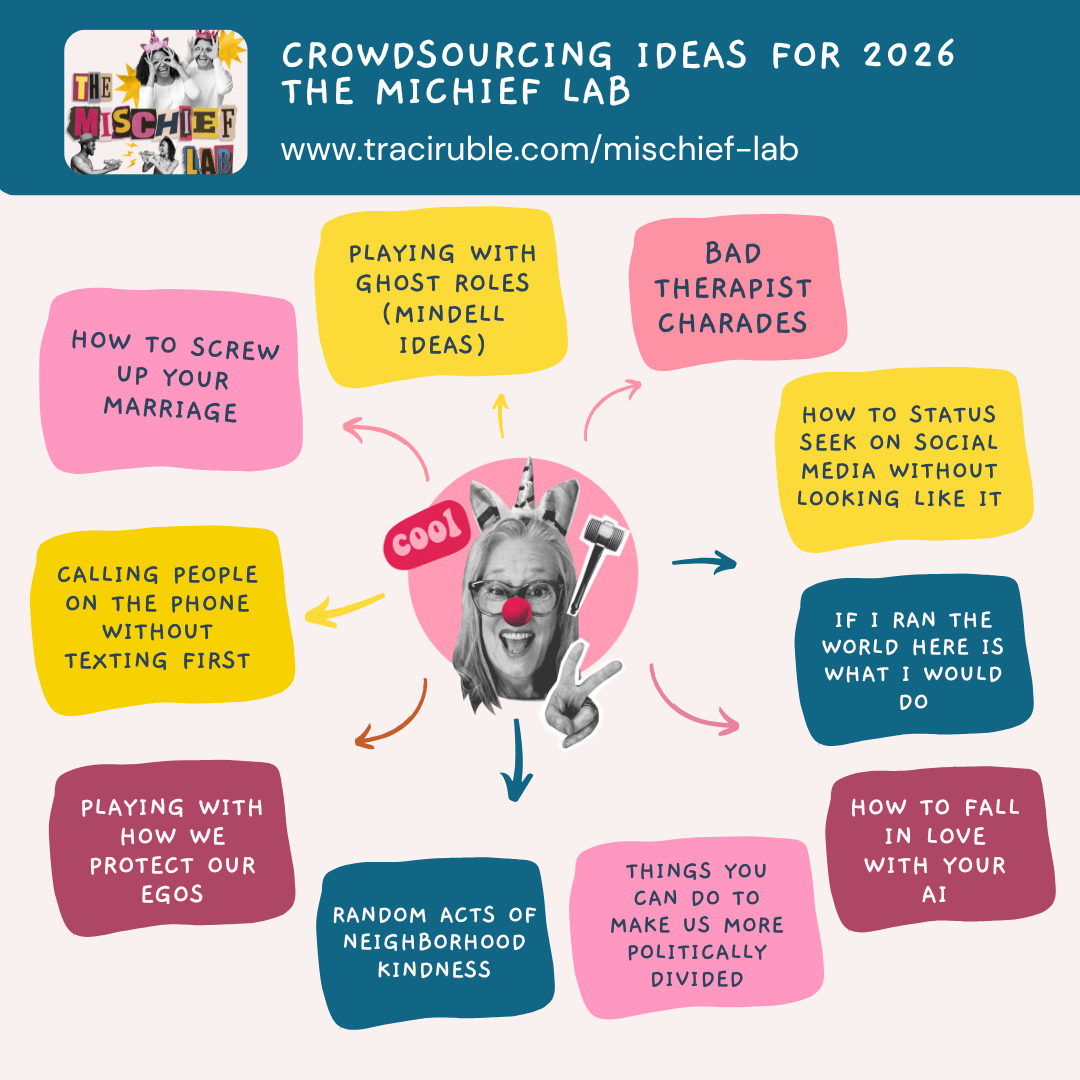
Weird Barbie stands in for the part of the psyche that wakes up when the system stops making sense, the part that says "something about this is not human and I refuse to mold myself into it." In a moment where Silicon Valley feels like a machine with no off switch, Weird Barbie becomes a symbol of psychic possibility - a reminder that even inside a system demanding perfection and performance, there is room for the glitch, the spark, the vivid thing that refuses to die. And I have picked this role up for the field. I realize now the devotion to creating The Mischief Lab was part of that. Workshops: in-person or online, that are weird, useless, and irrelevant. Bad Therapist Charades. If I Ruled The World. Five Ways To Ef Up Your Life. Writing Bad Poetry. You get the vibe. If AI is going to do all our writing and make all our art for us, where are we going to keep our souls? And to be clear, The Mischief Lab is not corporate personal growth or teambuilding workshops.
Where This Leaves Silicon Valley, Burnout, and Anyone Trying to Survive 2025
If you’re a tech worker, founder, or human in the Bay Area feeling this shift-you’re not imagining it. Something real is happening. Happily not for everyone, I don’t think it is forever, and there are great folks holding down the fort.
But here is what you need to know: 996 isn’t returning as hustle. It’s returning as fear.
And therapy-real therapy-has to meet the moment. Not with optimization. Not with “best practices.” Not with insurance-friendly protocols.
But with humanity. With imagination. With vital relationship. With an understanding that people are not thriving right now-they’re surviving.
And survival is a valid place to begin. It is fine. We can do this.
But it is not where we have to end. It is not where we will end. I am confident of that. But for now, I am honing my skills to keep embers alive. To meet people where they are.
FAQ: Common Questions About Burnout, 996, and Mental Health in Silicon Valley
What does “996” mean?
996 refers to a work schedule of 9 a.m. to 9 p.m., six days a week. It originally described extreme work culture in parts of China but is now being used by workers in Silicon Valley to name the new pressure to overwork.
Why is 996 showing up in Silicon Valley now?
AI acceleration, layoffs, fear of obsolescence, global competition, and economic uncertainty have created a survival-oriented work culture. People feel they must prove their worth through hours because productivity expectations are rising.
How is AI contributing to burnout?
AI has become a psychological comparison point. People feel they must match the speed, perfection, and tirelessness of AI systems. This triggers deep insecurity, shame, and a sense of never being “enough.”
What is burnout?
Burnout is not just exhaustion. It is a collapse of meaning, vitality, motivation, and emotional capacity. In Silicon Valley right now, it often looks like numbness, flatness, fear, and a sense of disappearing into work.
How does therapy help burnout?
Therapy cannot remove external pressures, but it helps restore humanity, internal safety, imagination, and emotional resilience. Many clients aren’t seeking optimization but a place to feel human again.
What is transference and how does it relate to AI?
Transference is when your past emotional patterns shape how you relate to people (or systems) in the present. With AI, many people unconsciously relate to it like an all-powerful parent or flawless sibling they must keep up with.
Why does Silicon Valley feel like it has “regressed”?
Using Erikson’s developmental model, Silicon Valley has slipped from a mature stage (generativity) into a younger one (industry vs. inferiority). This shows up as insecurity, comparison, performance anxiety, and fear of irrelevance.
What is Process Work and how does it explain burnout?
Process Work, a model from Arnold Mindell, says systems have deeper messages beneath surface symptoms. Burnout signals the culture is over-identifying with machine-like functioning and losing connection to human limits and soul.
How can someone survive 996 culture without losing themselves?
While structural change is needed, individuals can:
Find spaces where imagination and emotion are still welcome
Reconnect with body cues instead of overriding them
Build relationships that reflect their humanity
Work with therapists who can hold more than “distress tolerance”
Is wanting rest or humanity a weakness in tech?
No. It is a sign of psychological health. Burnout is not a failure of resilience but a natural response to inhuman expectations.
If you have more questions or want support navigating this moment, reach out. You don’t have to face Silicon Valley’s identity crisis alone.
Related Searches (to help readers & improve SEO)
Silicon Valley burnout 2025, Bay Area therapist burnout, tech worker mental health, AI anxiety, AI mental health crisis, 996 culture meaning, how to survive tech overwork, therapy for tech stress, AI work pressure, Silicon Valley identity crisis.