
How We Are Psychologically Creating the Political World We Fear
(And Why Cyclical Psychodynamics Has Me Re‑Thinking Change in Psychotherapy After 22 Years in Practice)
I have been a therapist for over two decades, and I have never been a “one theory” person. I have always been suspicious of anyone who is.
I have been drawn to psychodynamic and analytic thinking for a long time. There is something about depth, unconscious process, relational patterning, and history that feels honest to me. But if I am being transparent, many of the consultants, supervisors, and teachers I encountered in those analytic worlds felt… off.
Too heady. Too disembodied. Too enamored with their own insight. Sometimes quietly authoritarian. Sometimes explicitly on a power trip. I often left those spaces feeling small, talked over, or subtly positioned as the one who “didn’t quite get it yet.”
On the other hand, the more behavioral and cognitive traditions never fully worked for me either. They often lacked meaning. They could be elegant and effective in narrow ways, but were too frequently stripped of their emotional, relational, cultural, and historical context. At their worst, they colluded with abusive systems by helping people adapt to conditions that should not be adapted to.
And then there were the humanistic and experiential approaches. I love their heart. I love their respect for lived experience. But at times, they felt overly anecdotal, insufficiently precise, and sometimes reinforced patterns that actually needed to be interrupted.
For years, I felt like I was moving between worlds, borrowing what worked, translating constantly, and never quite finding a home.
And then, somehow, absurdly late in the game, I fell into Paul Wachtel’s work.
Cyclical Psychodynamics, in Plain Language
Here is the simplest way I can describe Paul Wachtel’s core idea:
We are not stuck because of one bad thing that happened to us. So stop getting intellectually high off of Instagram diagnosing of yourself or your friends.
We are stuck because the ways we learned to protect ourselves keep recreating the very situations we are trying to avoid. Said more bluntly: You are living your life trying to prove the effed up conclusions about love and life you concluded at a woefully painful time as fact. Your behaviors are helping confirm your conclusions.
Cyclical psychodynamics focuses less on origins and more on maintenance.
Not “Where did this come from?” but:
What keeps this going right now in my life?
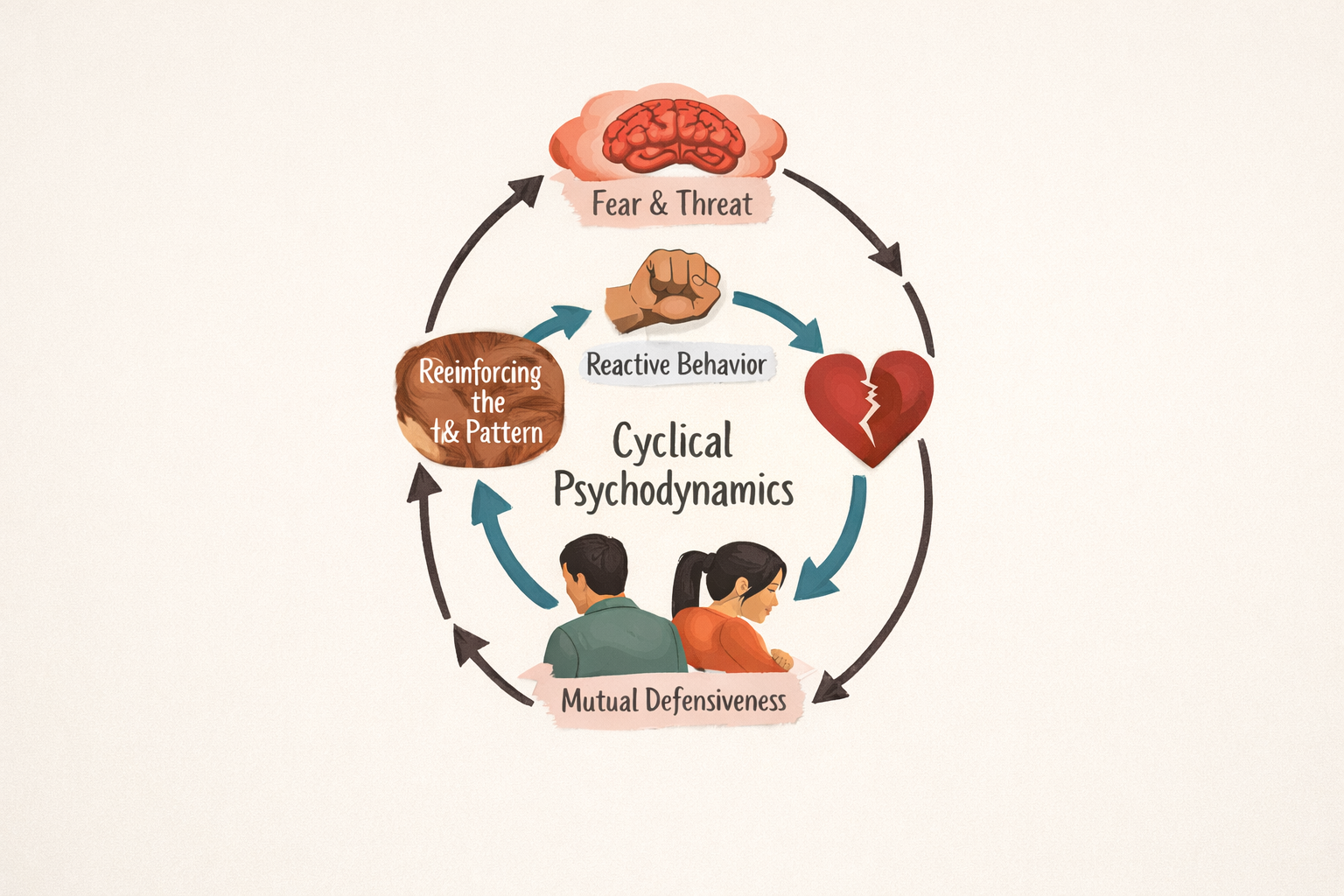
The cycle usually looks something like this:
• I develop an expectation or fear based on past experience
• I behave in ways meant to protect me from that fear or expectation
• Other people respond to my defensive behaviors
• Their response ends up confirming my original fear or expectation
• The behavior pattern gets stronger with every fear I confirm and simultaneously more invisible ( even though the outer suffering is very visible).
Our defenses, kind of like agentic AI, are trying to prove themselves correct and ensure they survive. The cool thing though, and why I have this puppy wagging its tail in excitement right now, is that with this wisdom we can stop the cycle. We can stop creating our wounded worlds over and over again. It is complex work that takes some patience.
Popular psychology and medicalized models of psychotherapy often start from the assumption that something is broken and needs fixing. I have never found that to be particularly motivating to people and frankly not very accurate.
From a cyclical psychodynamic view, we have miraculous psyches. We adapt. We protect. We survive. Our strategies are not defects; they are intelligent responses to the worlds we grew up in.
The trouble is not that we learned to protect ourselves. The trouble is that as our lives expand, we keep using the same protections and then unconsciously organize our present lives to prove they are still necessary.
What this means is that the work of psychotherapy is not about blaming the past or simply forcing new behaviors, we learn to challenge our perceptions by increasing our embodied capacity to bear uncertainty, and stop reinforcing these defenses. It is kind, curious, respectful work.
It is about noticing how we are unknowingly recreating familiar emotional worlds, sometimes decades later, by the very strategies that once kept us safe.
Wachtel also rejects the false war between psychodynamic and behavioral thinking. Thank you, Dr. Wachtel. About time. Insight alone does not change people. Behavior change without meaning does not last. We need both. And I will add Juliane Taylor Shore and the experiential folks - we need limbic system and brain-based rewiring.
I said to a friend the other day, "I haven't been so inspired in my work in a long time." I just think this is a very exciting time to be a psychotherapist, despite AI making some therapists nervous.
How This Helps Me Make Sense of Our Political Insanity
I want to pause for a moment and name something directly. For many people, what is happening in the U.S. right now is not abstract or theoretical. I get abstract and theoretical as a way to find coherence. It is how my brain works. But I don't want what follows to deny that some people are being actively harmed by those in power. Immigrants, trans people, journalists, civil servants, protesters, and others are dealing with real material consequences in their bodies, their families, and their livelihoods. This article is not asking anyone to stay calm or regulate their way out of danger. But it is a deep-thinking attempt to understand how fear moves through individuals and groups so that it does not take over our relationships, our movements, or our ability to respond wisely to what is actually happening. I don't want fear to create the world we do not want.
If you are terrified and freaking out - that makes total sense. And this may not be the piece that will feel soothing right in this moment and because I care, I say pause here and see if a think piece would be supportive to you right now. If yes, read on.
So I started playing with the ideas of cyclical psychodynamics, and I thought, "Huh, how does this map onto U.S. Politics right now?"
What follows is not about who is right. I have been listening on sidewalks for 11 years. I hear people up close and personal. I know people are good at the root, and that our psychologies make us susceptible to creating our wounded inner worlds on the outside of our skin. I have many high school classmates who are deep ICE and Trump supporters. I have clients and people I truly love who are Trump voters. And I have friends that share activists points of view I do not. I think this psychological frame helps us inquire more deeply into what people are protecting, personally and systemically, often without conscious awareness, and how those protections quietly build the world they are the most afraid of. It is me asking 'How the ef did we get here, and how am I culpable or making it worse?" And more importantly, how can this free us up to start talking about what we want to build?
What Many Anti‑Trump People Are Protecting
Most people I know who are intensely anti‑Trump are not protecting their political opinions. They are protecting something far more personal.
They are protecting:
• A fear that the world order can fall apart very quickly and make us very unsafe
• A fear that bullying and cruelty will become normal
• A fear that no one will step in when rules are broken
• A fear of watching something precarious like representative democracy, replaced by authoritarianism
Many of these people grew up believing that institutions, democratic norms, and a shared reality (we all roughly read the same news) mattered. For people who largely benefited from that arrangement, or at least felt protected by it, watching those structures weaken can feel like standing on ground that is suddenly cracking open, ready to swallow them.
I want to be careful and honest here. I have noticed that the most intense forms of moral policing and speech control often come from people who have not historically felt unsafe in America. People who, until recently, trusted that the system worked well enough for them. When that trust breaks, fear can harden quickly into righteousness that looks a lot like authoritarianism. And this is a great example of cyclical psychodynamics.
By contrast, many people who have lived for generations on the underside of American power, people for whom the system was never benign, are responding very differently to this moment. Their skepticism about power has been a constant and they have rarely expected to be treated fairly by power. Their fear is less shocked. And they are more measured in their responses and less about one-upping or morally punking the other side and more about action that works.
Naming this is not intended to be an attack but a provocation of the group I most identify with for the sake of being more skillful in our actions. It is an attempt to notice how unexamined privilege, when feeling scared and morally righteous, can quietly morph into control.
And yes, I feel this fear, grief, and anger too. I am not outside this system. I get all righteous and "caller outery" too. But, now I have a bunch of stuff I do from body stuff, to relating, to creativity, to therapy, to learning to not vomit my terror onto the world. And then, with this piece, I am trying to understand how we got here from a deeper psychological place.
The problem I see lately is that constant vigilance becomes a way of living.
I saw a quote on Somatic Experiencing International's site that read "A perpetual state of threat combined with a perpetual state of powerlessness is what wires learned helplessness into the nervous system."
Over time, this vigilance makes people with different political views automatically categorized as dangerous people. Curiosity feels irresponsible or traitorous. Softness feels naïve. People are scanned for risk rather than met as humans with a whole universe of complexity inside of them. And meeting people with that curiosity has the power to change minds. Meeting people as the enemy does not.
This kind of vigilance creates a world where trust is impossible, and everyone is on edge, which, ironically, is exactly the kind of world they fear authoritarianism creates anyway.
So, in a pure psychodynamic sense, the fearful vigilance about authoritarianism helped create fertile ground for authoritarianism.
What can change this, starting now:
It looks like someone who notices they’ve read the same breaking-news headline five times in ten minutes, closes the app, and suddenly feels the tightness in their chest they’ve been outrunning. They take a walk, cry, shake it out, or sit quietly long enough to realize the fear isn’t information, it’s grief and anger asking to be felt.
It looks like staying at the dinner table with a relative or friend whose politics make your jaw clench, and choosing to stay a curious human rather than persuasive. Not explaining. Not diagnosing. Just listening, setting a boundary when needed, and remembering this is a person, not a position.
It looks like saying out loud, sometimes awkwardly and without polish: I miss the country I thought we were. I miss feeling safe. I miss trusting institutions. Naming loss instead of converting it into constant outrage.
And it looks like putting energy where it can actually make an impact, helping a neighbor, showing up at a school board meeting, organizing locally, volunteering, mentoring, doing something concrete that restores a sense of efficacy instead of feeding the endless sense of threat.
Fear does not get better through vigilance. It heals when grief is allowed, relationships are deeply cared for, and people experience real, embodied agency again.

What Many Pro‑Trump People Are Protecting
Many pro‑Trump supporters are not primarily protecting Trump.
They are protecting:
• A sense of personal dignity and the identity structures they feel they are losing to this ever progressing world
• A fear of being erased or looked down on
• A fear of being powerless in a changing world
• A fear that the rules and social norms will keep shifting, and they will always be wrong or left out
For many, Trump symbolizes permission to stop feeling bad or apologizing for harms of the past. He represents strength in a world that, for this group of people, has felt both humiliating and unfamiliar.
But when loyalty to a person like Trump hardens into identity or "this is who I am", something problematic happens for these folks too.
Anyone who criticizes the leader feels like a dangerous enemy. Complexity or thinking critically feels like a betrayal of one's identity. Cruelty starts to feel justified because it restores power.
What gets recreated, from a cyclical psychodynamic lens, is a world where domination replaces trust and where only force feels protective. They wanted to protect from shame, humiliation, and being looked down on, but in doing so, created a world of shame, humiliation, and looking down on others. They create the world they don't want. This, to me, is what is so cool about cyclical psychodynamics. It helps us see how our defenses prove or recreate the thing that hurt us.
What can change this, starting now:
Instead of treating dignity as something Trump gives or takes away, imagine locating it somewhere no politician can touch.
That looks like a man who stops doom‑scrolling pundits who tell him who he is supposed to hate and instead puts his energy into being competent at something real, his work, his craft, his body, his relationships. Dignity grows when you can point to something you do, not just something you oppose.
It looks like naming losses out loud, "I miss feeling respected," "I don’t recognize the country I grew up in," "I’m afraid my kids won’t be okay", rather than letting those losses harden into anger that needs a target.
It looks like building respect in places untouched by politics: being someone others rely on, mentoring, fixing things, contributing locally. Power that comes from usefulness does not need domination to survive.
And it looks like practicing a different kind of strength, strength that protects without humiliating, that can hold disagreement without annihilating the other person.
Strength that requires an enemy is not strength. It is fear wearing armor.

A Friendship Breakup Through a Cyclical Psychodynamic Lens
I want to include one more example that is more "everyday life" and about me so I have some skin in the game here too. This story helps show how the same psychological cycles I’ve been describing operate in intimate, everyday relationships.
I had a close friend who was a therapist. She lived alone, had very few friends besides me, and was in a relationship that was emotionally abusive. She had survived a childhood where boundaries were repeatedly violated and no adult intervened. No one named the abuse she endured. No one protected her.
As an adult, safety came to her through certainty about ideas and the world. Clear explanations, firm conclusions, and unambiguous moral narratives helped her feel like she understood the world. Uncertainty felt really dangerous. In a time marked by rapid social change, this left her especially vulnerable to explanations that promised clarity and inevitability like conspiracy theories. And oddly, hopelessness felt stabilizing.
Although she herself was queer, trans people, immigrants, and Muslims gradually became symbolic stand-ins for the perpetrators who harmed her when she was little. Support for these groups by the public registered as further evidence that no one would protect her. Her fear organized itself into rigid ideology.
In our friendship, I represented something that was both regulating and destabilizing. I am comfortable with uncertainty and complexity. I can sit with anxiety and grief without needing immediate resolution. Something about my quirky complexity was enlivening and challenged her core belief that safety only comes from certainty.
I stayed longer than was good for me, and that matters. I stayed because I was lonely at that time in my life, and because I have a long-standing cyclical psychodynamic pattern of adapting downward in relationships to preserve connection. My role was endurance. I translated her point of view in my head so I could hear the wild conspiracy theories she believed in with kindness. I softened. I accepted an imbalance, and she did too.
This dynamic we created helped stabilize her defensive system. My willingness to stay without fully naming the cost to myself reinforced her belief that relationships are safest when they are narrow and unchallenging. I became part of the structure that allowed her certainty to remain intact.
The rupture came through a brief exchange of voice messages one night. She spoke with quiet finality about always being alone and never feeling safe. I responded that I did not agree and that I experienced this as a choice rather than an unchangeable fate. I also named something I had been avoiding: that she was a therapist who was not in therapy herself.
She never spoke to me again.
From a cyclical psychodynamic view, this ending makes total sense. Her withdrawal restored internal order. It removed a relationship that disrupted her certainty. It confirmed her belief that closeness is unsafe and that aloneness is inevitable.
My part is equally important. When I finally spoke plainly, I stepped out of my own pattern of self-erasure. The relationship could not survive that shift. It was not built to tolerate mutual challenge; it was built around my accommodation and her certainty.
This is not a story about a villain and a victim. It is a story about two coherent defensive systems that briefly interlocked and then separated when one person stopped playing their assigned role. When we break out of rigid roles, relationships always get impacted.
What I like about cyclical psychodynamics is that it doesn't have this "who is psychologically healthier" power game; it simply asks that we see how we were both participating in a system that could not grow.
That is what cyclical psychodynamics helps make visible, and how change is then made possible instead of recreating the past over and over and over again.
Apply This To Your Own Life
If you are curious about applying this lens to your own life, here are some questions I ask myself regularly:
• What problem behaviors have I been trying to change but they are stuck? What problem is this behavior solving for me?
• What feeling would I have to face if I stopped this behavior pattern?
• How do my protective beliefs and behaviors invite predictable responses from others?
• Where am I regulating or taking care of someone else at cost to myself?
• Where am I staying in a job, relationship, activist group etc. because the presence is soothing, even if the dynamic is limiting?
• What small interruption could loosen the cycle without overwhelming me?
These are not self-improvement questions. They are just honesty questions.
Why I’m More Excited Than I’ve Been in Years
What truly feels like the holy grail for me right now is the integration of Paul Wachtel’s cyclical psychodynamics with Juliane Taylor Shore’s work on self-trust, trauma, and integrated resilience. Throw in some process-oriented psychology that adds mythopoetic and power dimensions, and this feels like my clinical home.
The first two are neuroscience-informed. All of them reject reductionism. And they all honor meaning and change with respect for the nervous system's capacity, without flattening a kind of soulfulness about our humanity.
I have not felt this intellectually and clinically alive in years.
Not because I finally found the right theory, but because I finally found a way of thinking that helps people be weird, helps people change, and does so without telling them they are screwed up.
And honestly? That feels like coming home.