
A Step-By-Step IFS Parts Mapping Guide For More Loving Relationships

Photo by Wiki Sinaloa on Unsplash
This was originally a worksheet I gave to couples I work with in therapy. But I’ve decided to share it more widely here on my blog so anyone—whether you're in therapy or not—can begin to use Internal Family Systems (IFS) to better understand yourself in relationship. This guide will walk you through the core parts of IFS (Managers, Firefighters, Exiles, and the Wise Adult Self), offer a daily practice, and help you reflect on the inner patterns that shape your interactions. My aim is to make deep psychological work feel clear, human, and useful for your everyday life. I love knowing the history of a theory and IFS has had such good efficacy and impact research at John’s Hopkins and other places but still I like to know the backstory so sharing this great history of IFS from Pasterski’s website here.
Why Use This?
There are so many ways to understand ourselves. Psychologists have been trying to describe the psyche for over a century, which means there are a lot of frameworks to choose from. You may have heard of:
The Gottman Method
Terry Real's Relational Life Therapy
Imago Couples Therapy
David Schnarch's Differentiation Model
Sue Johnson's Emotionally Focused Therapy (EFT)
Dr. William Doherty's The Doherty Approach
Ellyn Bader's Developmental Model of Couples Therapy
And good old psychodynamics—looking at how the parts of a system interact to create the system.
And so many more (I just thought of Pat Love, Tammy Nelson, and so many more)
I’ve trained in many of these and continue to train in more. Why? Because no single model captures the full complexity of being in a relationship. Each offers a lens to understand a piece of the puzzle. IFS is one of those lenses.
And—important to name—frameworks are helpful, but never complete. Sometimes, the truth of your relationship isn’t nameable. It lives in the odd annoyances and tensions, accommodations and fears, conflicts and clinginess that don’t fit a model. That said, I like this one. It helps you track your unconscious, locate your parts, and feel what’s actually there without making anyone the bad guy.
In every framework, you’re working with feedback loops: how what I bring and how what you bring co-mingle and shape the relationship.
Couples therapy is always a dance between two personal histories, two nervous systems, two ways of defending and desiring. The project is learning to track that dance—what we each bring, how it sparks the other, and what we co-create together.
IFS blends well with psychodynamic ideas: just like defenses in psychodynamic theory protect us from unbearable feelings, so do the managers and firefighters in IFS. Both models ask us to gently bring awareness to what's been pushed aside and to stay curious, not critical so you can feel what wasn’t felt instead of living your life from defense mechanisms forever and always.
If you've ever found yourself thinking, "Why did I get so reactive just then?" or "I know this feeling, but I don't know where it comes from," this framework might help you locate and soothe those deeper layers.
How to Use This Guide
Get familiar with the three types of parts inside of you using IFS lingo: Managers, Firefighters, and Exiles.
Use the worksheet section to track your parts and share (if you want!) with your partner.
Practice daily connecting to what IFS calls your Wise Adult Self (IFS calls it Self with a capital S but I find that confusing so we will called it Wise Self or Wise Adult Self).
The Basics of IFS Parts
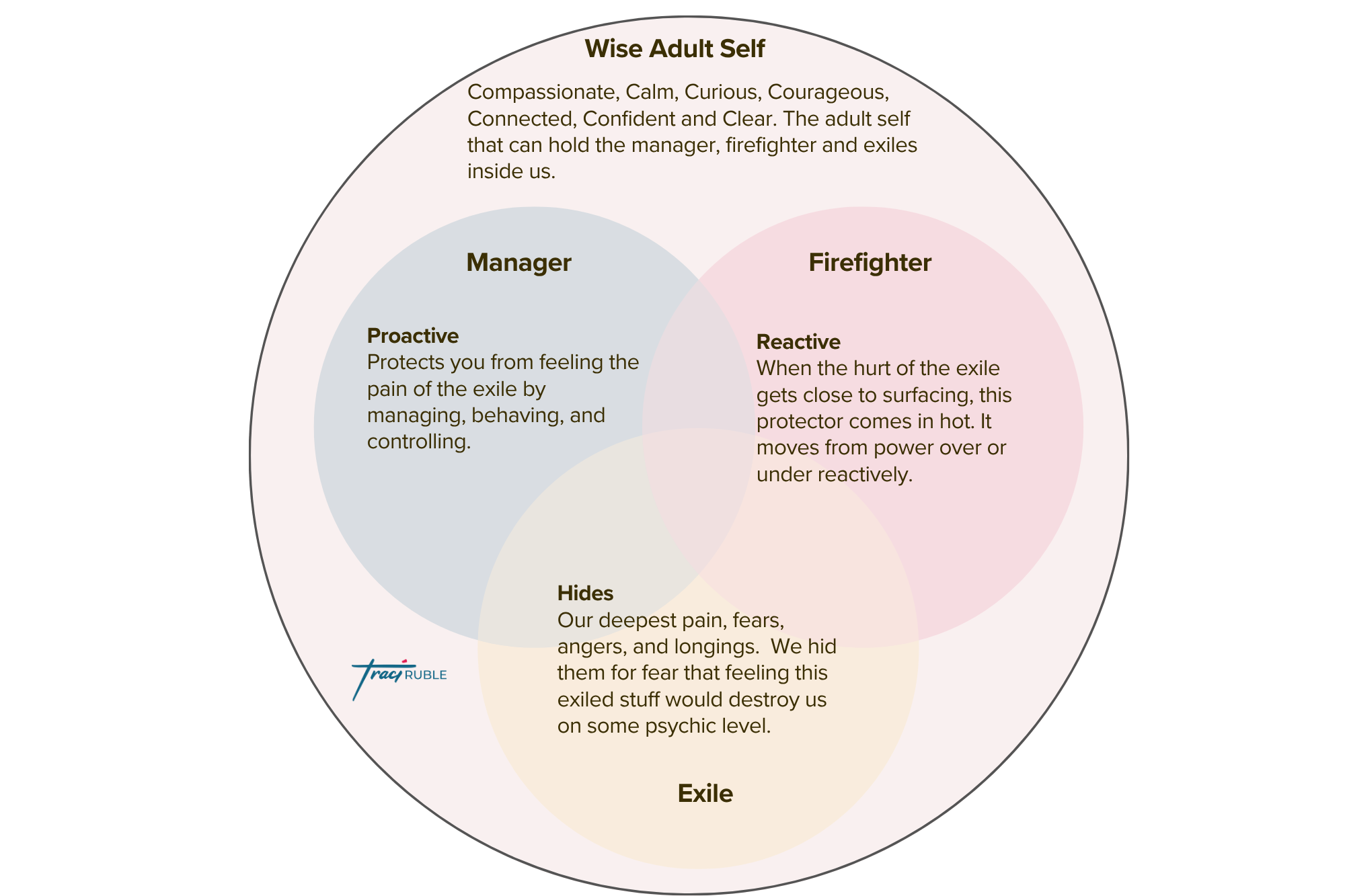
Exiles (Wounded Child Parts or Unbearable Feelings We Aren't Aware Of)
These parts hold the deepest of our pain. They often formed in childhood when we felt hurt, shamed, abandoned, or unseen. When big hard stuff happens or small painful stuff happens over and over again (like not having a parent emotionally present or being shamed for having needs), our system tucks these moments away. These parts get "frozen in time," holding those emotions.
A quick trauma primer: Certain early life experiences make us more likely to carry these exiles. These are called ACEs (Adverse Childhood Experiences), and include:
Emotional, physical, or sexual abuse
Physical or emotional neglect
Witnessing domestic violence
Growing up with a parent who has a mental illness or addiction
Losing a parent to separation, divorce, or death
Poverty, discrimination, and war
But really, these don’t have to be extreme or dramatic to leave a mark. I have had many clients find out someone close to the family died when they were an infant and the parents were too busy grieving to be attuned to them as an infant. Or they were tight on cash when they were little and working two and three jobs. Or they grew up in a family culture where intellect was good emotions were bad so there is a lot of emotional baggage left exiled away.
What helps protect against trauma? I say this because the field can get too fixated on wounding and were trauma surviving creatures. We are wired survivors. Even with adversity, protective factors can build resilience and have us not come out of childhood with big emotional wounds that need lots of therapy:
Having at least one adult who offers consistent emotional presence and care
Feeling a sense of belonging at school or in a community
Opportunities for creative expression or play
Feeling like you could share openly your distress and be soothed during by someone reliable
Agency to get help or support
When those protective factors are missing, exiles form. We often push them away because we’ve been taught to ignore or feel ashamed of our vulnerability. But they live inside us, waiting. Not to punish us, but to be felt and held. But back when we were little feeling exiled pain was way too much for a little kid. Part of therapy teaches us that "Oh I can actually feel this back log of feelings now step by step." Together you build that resilience by relating to me, your therapist, and learning to relate to your parts differently.
A tell tale sign exiles are lurking below the surface include:
You suddenly feel worthless after a small mistake
You fear rejection even when your partner is being kind
You get disproportionately hurt by something seemingly small . They often formed in childhood when we felt hurt, shamed, abandoned, or unseen. When big hard stuff happens or small painful stuff happens over and over again (like not having a parent These parts got "frozen in time," holding those emotions.
We often push exiles away because we’ve been taught to ignore or feel ashamed of our vulnerability or the feelings were just too damn overwhelming to feel alone. But they live inside us, waiting. Not to punish us, but to be felt and held.
Managers (Adaptive Child Parts in Terry Real's Language or Defense Mechanisms in Psychodynamic speak)
Managers work overtime to keep us safe. They try to prevent us from ever feeling the pain the exiles carry. Their motto is "never again."
Common manager roles:
The Controller: Keeps everything planned and in check
The Perfectionist: Tries to avoid shame through excellence
The Passive Pessimist: Avoids closeness to avoid getting hurt
The Over-Caregiver: Focuses on others to avoid their own feelings
Managers can help us survive. But they can also get in the way of intimacy by tightening control when we really need softness.
Firefighters (Reactive Child Parts)
Firefighters jump in when emotions get too hot. They don’t plan like managers—they react. Their goal is to shut down the pain as quickly as possible.
Sometimes this means:
Lashing out
Shutting down or to use a Gottman term, stonewalling
Reaching for wine, weed, porn, food, or social media
Firefighters aren’t bad. They just don’t want us to drown in the feelings that were once unbearable to our little kid self. But firefighters often flood our romantic relationships.
The Goal: Your Wise Adult Self
IFS believes we each have a core Self (or what I call the Wise Adult Self). This part of you is calm, clear, curious, compassionate, connected, courageous, creative, and confident. When you're in this state, you don't need to control or run away. You can relate.

But here's the tricky part: sometimes a perfectionistic manager can look like your Wise Adult Self. It might say the right things and sound very put-together. But you’ll know it's a manager if your body feels tight, feels burnt out and overworked, buzzed, braced, or your tone is clipped or pressuring. The Wise Adult Self feels relaxed, open, and grounded—like a soft belly breath or the calm steadiness of a loving grandparent.
Daily Practice to Access Your Wise Adult Self
Try this short practice:
Sit quietly and place one hand on your heart or belly.
Imagine someone (a person, animal, spiritual figure) who embodies warmth and calm for you.
Breathe into that feeling of calm, and say these words silently or aloud:
"I don’t have to fix anything right now."
"I’m here with you. I can listen."
"All parts of me are welcome."
Notice what changes in your body. Do you soften anywhere? Get more spacious?
What Your Wise Adult Self Might Say to a Manager Part:
“Thank you for working so hard. You’ve been doing this a long time. I’m here now—you don’t have to do this all alone.”
“It makes sense that you’re trying to keep me perfect so I don’t feel pain. I see how much you care.”
“You’re allowed to rest. I’ve got this.”
What Your Wise Adult Self Might Say to a Firefighter Part:
“I see you jumped in fast. You were trying to protect me.”
“That was a big feeling. I’m here. I can handle it now.”
“We can slow down. You don’t have to fix this with food or scrolling. I’ll stay with the feeling.”
The goal isn't to get rid of your parts—they're all trying to help. The goal is to listen to them and offer them sincere compassion from your Wise Adult Self, and create space for deeper connection with yourself and your partner. (You will soon be able to start listening with compassion for your partner's managers and firefighters instead of blame once you have mastered compassion for these parts of you.) A great reminder list of words is that signal Wise Adult Self part of you is leading include; calm, clear, curious, compassionate, connected, courageous, creative, and confident. When you're in this Wise Adult Self state, you don't need to control or run away. You can relate to all the parts of you and all the parts of your partner.
The goal isn't to get rid of your parts or your partners—they're all trying to help. The goal is to listen to them with your Wise Adult Self, offer compassion, and create space for deeper connection with yourself and your partner.
Practice & Reflection Worksheet
Start here:
Track your parts this week.
Practice sitting in your Wise Adult Self daily.
FIRE-FIGHTERS
Did I get reactive today? How?
What was the trigger?
What vulnerability or pain was I protecting?
Do I get an image of this part (age, personality, energy)?
MANAGERS
What manager parts came up today?
How did they feel in my body?
What were they protecting?
How did they help me? Were they also limiting?
WISE ADULT SELF
Was there a moment I felt calm, courageous, clear, or compassionate today? What helped me get there?
If not, can I imagine accessing those feelings now? Use an image or memory.
Can I offer a kind word to a part that was active today?
Make a Parts Map
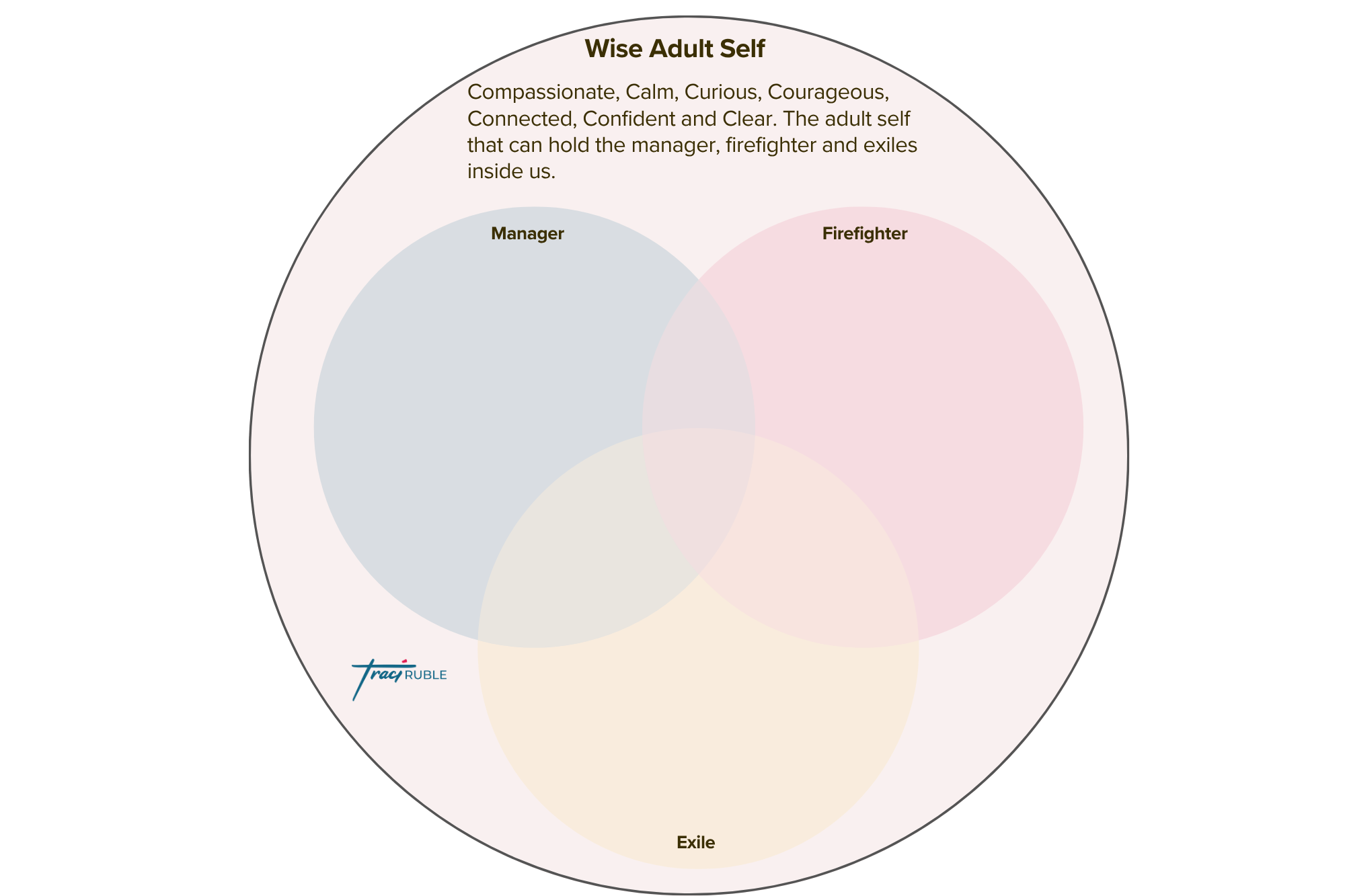
On a separate sheet, draw a circle. In it, place:
Managers (often on the outer edges)
Firefighters (near the managers)
Exiles (tucked inside)
Wise Adult Self (at the center)
Label the parts you know. Use fun names if it helps: "Critical Carter," "Worried Wanda," "Shut-Down Sam," etc. Invite curiosity. Write one compassionate statement to each part you identify.
Stretch Goal:
Do the exact same for your partner.

Listen for your partner’s parts of self and rather than punish them offer their parts compassion.
This isn't about doing it perfectly. It's about building inner relationships that make outer relationships easier. And remembering, we're all made of many parts—you're not broken. You're a system longing to be led with love.
In therapy, what we do together is begin to identify how your managers and firefighters interact with your partner’s managers and firefighters. Over time, you’ll also begin to learn what exile material is underneath each of your defenses. As we track this dance—the emotional choreography you co-create—you can start to shift things. Not by blaming or fixing, but by feeling with and for your parts and your partner’s parts. This is where real healing begins.