
Are You Spiritually Bypassing On Your Psychedelic Journey? Warning Signs to Watch For

I just returned from a psychedelic retreat and feel deeply grateful for the possibilities plant medicines hold for healing in ways psychology alone sometimes cannot reach. This retreat stirred up many memories of my graduate school days, which hadn’t happened in previous journeys. I sat with that curiosity, and this article is what emerged.
I attended a deeply spiritual graduate school, the California Institute of Integral Studies, where psychology was taught alongside Eastern philosophy, transpersonal psychology, and spirituality. What an incredible and holistic education. I am still grateful for it today, even though back then we were often seen as the weirdos. During that training, two terms came up often: spiritual materialism and spiritual bypassing. As I’ve entered the world of plant medicines and psychedelic journeying, those ideas emerged in my psyche again. I think because I was preferring to stay in “blissed out” and in the land of the “righteous journeyer”. So this is a loving playful call-in to myself, most of all.
Psychedelic experiences can lead to profound transformation, but they can also become subtle forms of avoidance through escaping into blissful transcendence, and transcending can be a trickstery move by the ego. This article is not meant to poo poo transcendence but to hold the paradox of both transcendence and transformation - because we need both to heal.
First, what are spiritual materialism and spiritual bypassing? Tibetan Buddhist teacher Chögyam Trungpa coined the term spiritual materialism in his book Cutting Through Spiritual Materialism. He warned that the ego will use anything, even the sacred, to build itself up. Meditation, therapy, psychedelics, and prayer can all become ways to reinforce identity instead of dissolve it. Spiritual materialism is when the self puts on holy robes and declares itself enlightened. It looks like devotion, but it is really avoidance.
One of my favorite books from grad school, Toward a Psychology of Awakening, introduced John Wellwood’s idea of spiritual bypassing: using spiritual beliefs or practices to avoid facing painful emotions, wounds, or psychological work. In bypassing, spirituality – or sometimes psychedelic use – becomes an escape hatch from our humanity rather than a way into it. It shows up as premature forgiveness, constant positivity, or focusing on the light while disowning the dark. Wellwood warned that without integrating our shadow, spirituality can actually keep us stuck instead of bringing freedom. Spiritual bypassing is the tender twin of spiritual materialism; both are avoidance disguised as transcendence.
What integrating the shadow means
Integrating the shadow means inviting the disowned or feared parts of ourselves back into awareness with honesty and compassion. It’s less about fixing and more about befriending. Practically, it looks like noticing moments of envy, irritation, or judgment and asking, what part of me wants to be seen here? It means slowing down before reacting, naming feelings aloud, and bringing unconscious material into consciousness, not to get rid of it but to include it with compassion. And contrary to pop psych, shadow doesn’t mean brooding dark stuff. We can put gentleness, joy, ease, rest, spontaneity, and wisdom into shadow too. Shadow means “not in the light” rather than “sinful” or “evil” parts of us.
Integration is when we can hold a wider range of our humanity, love and hate, calm and chaos, without needing to exile any of it. Holding complexity is super hard for the brain without practices to help us cultivate it. My recent journey was about including the complexity of my inner jerk or jackass, as the medicine called it. But integrating jackassery is not about giving my jackass a hall pass to be a jerk at will, nor was it about proving I had turned that jackass into a unicorn of love and light. The jackass is welcome here too, as is, and in that acceptance, as Jung says, it transforms. In community, integration looks like letting people mirror our shortcomings without collapsing into shame or blame. Shadow work grounds the spiritual path in ordinary life, where insight becomes relationship to oneself rather than a performance for other people. People pleasers beware!
When I arrived home I had some irritation come up with a person and the first thing I wanted to do was “bliss out into a love bubble” to be all “love and light”. I stopped myself from doing that. Stayed with it and studied the process unfolding, and decided to share a few helpful tips for integrating shadow after a journey that serve me but there are a so many more ways to do integration work too.
Feel the irritation without analyzing it. Just notice it as simple energy moving in your body.
Welcome it in. Come into a warm, curious relationship with whatever is showing up: irritation, judgment, envy, avoidance, or overdoing. Imagine smiling at it and saying, “Well hello, you.”
Ground the body. For many of us in Western culture, emotional discomfort kicks the brain’s task mode network into gear. It starts analyzing, judging, and before we know it, rumination takes over. My mantra is, “Keep it low and slow, Traci. Low and slow.” That means grounding into the body, slowing the breath and mind, and simply observing without trying to fix or figure it out.
Ask the deeper questions. Once I’m grounded, I imagine a wise part of me holding what I’m noticing, and then I gently ask, “What part of me is bothered here?” and “What is the unmet longing or need underneath this?”
Wait. The first insight is rarely the truest one. I hold the initial answer lightly and keep feeling for more possibilities, letting several answers emerge over time.
Parts play. When I have a few insights, I might let the part of me that is irritated talk with my wise self, or I might have the part of me that is bothered and the person irritating me “talk” to each other with loving kindness. Yesterday, when I tried this, I realized they both wanted the same thing. The irritating person was a projection of something in me I had hidden in shadow. I imagined my wise self placing both me and my colleague on her lap, and we all giggled together.
Deepen the embodied transformation. Then I returned to my body, low and slow again, and noticed a wave of compassion for myself and the other person. That capacity to sit with this all instead of reacting or fixing, honestly, has been supported by my psychedelic work, which I have integrated into my own therapy process.
This is why integration therapy can be so powerful if you find the right person. I was so inspired this time that I am finally exploring training as an integration therapist myself.
Trying to transcend instead of transform
Because psychedelics deal in the land of the transcendent, it’s easy to reach for transcendence instead of transformation. Spiritual materialism and spiritual bypassing can both be ways to avoid the real work of change. Dr. Brian Tierney, a somatic psychologist and adjunct professor at my old grad school, said on The Third Wave Podcast: “There can be a tendency to idealize embodiment, psychedelics, religious practice, even theories about life. Ideals give us a mission, but they can also override reality.”
You can watch the whole thing here on YouTube: https://www.youtube.com/watch?v=hysDrxESaZg
I’ve been confronted with this in myself and seen it in many spiritual and psychedelic seekers. On some level, we all have a part that wants to be seen as special. I do too, and she and I have a love fest every day. The more I love her, the less she needs to live in comparison. I even use social media as a practice ground. Can I be online and not get caught in the “specialness” trap (despite the algorithms stoking that flame in us all)? Full confession, I’m at 50% of the time right now.
You can tell the specialness trap is operating when you hear poker tells like: “holding space,” “transcending,” “the medicine is still working through me,” or “I’ve gotten to the other side.” Or any belief in what Tierney calls “arrivalism”—the illusion that we can reach a finished state. It’s more like a big pot of soup we become a little more conscious of, rather than a linear journey. One teacher drew me this circle. I show this to clients all the time. I say, "See this circle. The circle is your conscious mind and the outside of that circle is your unconscious. Look what happens the more conscious you become. The more your conscious mind has access to the unknowable unconscious (or universe, if you want)."
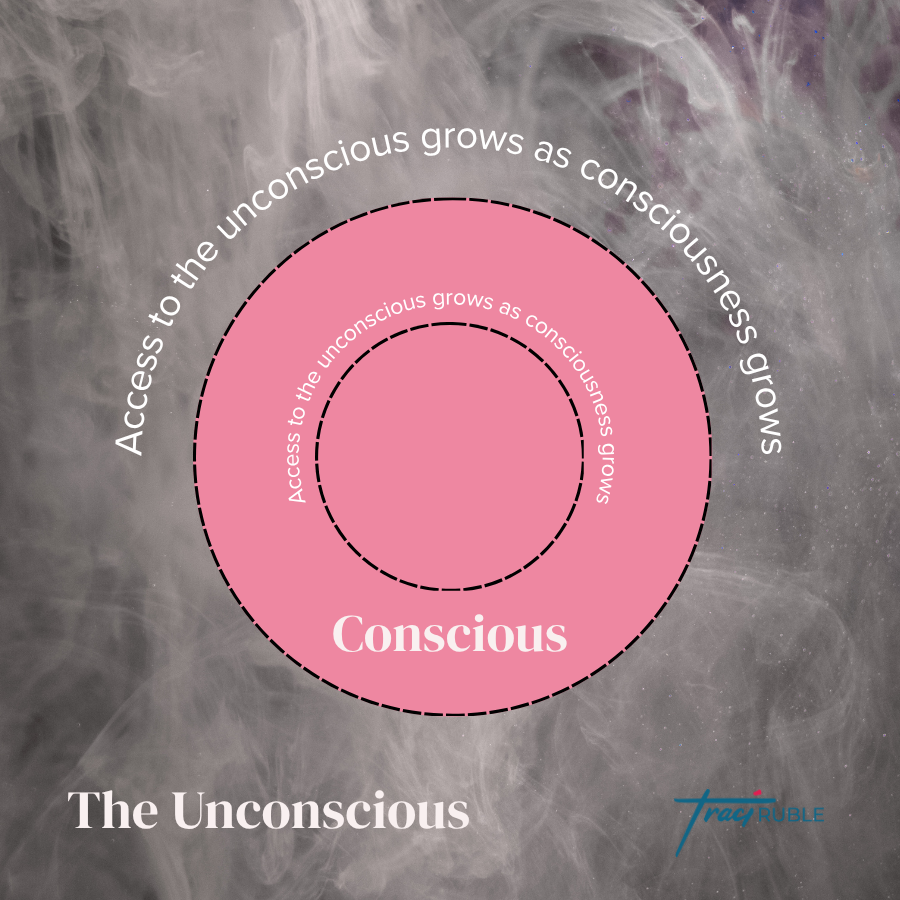
In grad school, I met many would-be gurus who had the keys to the universe. It’s an easy role to slip into when you swim in spiritual waters long enough. But I’m after transformation for myself and my clients, not transcendence. Dr. Tierney reminds us that transcendence often hides a wish to numb, to hover above contact with very human experiences like envy, rage, and need. Transformation asks us to change our relationship to these experiences, not to get rid of or rise above them. I love this article on avoidance mistaken as healing here.
Playing with the Inner Guru
I tease my guru part, and that teasing was strong in my recent journey. It’s a playful way to integrate shadow and to have one good compassionate chuckle at yourself. It reminds me of when my son would try to push his little brother off my lap and claim it as his own. I’d tickle him and say, “You want to be mama’s only sweetie.” Usually followed by a cuddle, a giggle, and an offer to take turns. To be there with him in the loss of not being special, but in a generous, kind, silly way. Just like my son, the want-to-be guru wants power, admiration, and certainty, and underneath all of that is a terrified child longing to be seen as good. The trick is not to banish her but to hold her with humor and love. As soon as we touch the numinous, that vast mystery that blows the ego’s circuits, we will inevitably meet our inner materialist too. The ego will want to own the light. It always does, just like my kid wanted to own my lap.

Tell-tale signs of spiritual materialism
Turning spiritual experience into identity: I am the awakened one.
Using language of light and vibration to bypass pain or anger.
Collecting peak experiences instead of integrating them.
Needing others to validate one’s “spiritual depth.”
Feeling morally superior to the “unenlightened masses.”
The psychodynamics beneath it
From a psychodynamic lens, spiritual materialism functions as a defense against unbearable feelings like:
Shame: If I’m spiritual, I can’t be bad.
Insignificance: If I’m enlightened, I matter.
Chaos: If I’ve transcended, I’m safe from the mess of being human.
Dependency: If I’m the teacher, I don’t have to need anyone.
It’s a narcissistic defense (not narcissistic personality disorder—that’s different; I wrote about the difference here) dressed in divine clothing, a brilliant strategy of the psyche to avoid humiliation, grief, and longing. Beneath your inflated guru and mine is a wounded soul who can’t bear to be ordinary. My analyst once said to me, “Don’t force your gifts to make you special. They’re just gifts, not better or less than anyone else’s.” I beamed and said, “Wonderful. That means every human’s gift is a treasure, so I’d like to kindly give up my job of being special and become a treasure hunter.” Said with pride, not specialness.
The collective and archetypal roots of spiritual materialism and spiritual bypassing
Collectively, spiritual materialism mirrors our Western cultural shadow, the obsession with progress, mastery, and transcendence. (Hello, capitalism!) We consume spirituality like everything else: to feel special, to escape uncertainty, to win. The archetype of the Hero looms large here, climbing the mountain of enlightenment rather than kneeling at its base in humility.
Jung would say the ego has confused itself with the Self, mistaking the divine light for its own reflection. In everyday terms, this means we mistake glimpses of deep wisdom or connection as proof that we are the source of that light rather than a participant in something larger. It’s like confusing the sun with the mirror that reflects it. The result is inflation. Our culture is so damn addicted to achievement, we just can’t easily metabolize these mystical experiences, so we “eat them” instead. I once described one psychedelic journey as if I were trying to eat the sky, and in some ways, that’s materialism at play in an embodied way.
Brian Tierney on meaning, safety, and pacing
I want to weave in a few threads from that Brian Tierney podcast interview I mentioned earlier that helped me make sense of my recent journey without accidentally feeding the guru part.
Meaning-making is normal, and it needs pacing.
In the brain, big experiences shake up networks that help us tell our story and focus attention. The default mode network handles autobiographical meaning and mental time travel. The salience network says, “this matters now,” and points attention inward in our bodies or outward. The task network helps us stay focused to get sh*t done. One important note: Trauma tangles these networks, so a journey can flood us with too much, too fast. Here is another podcast interview I think that covers trauma in more detail. Translation: insight without pacing can become overwhelm, and overwhelm can become a new spiritual costume for the ego. Spiritual bypassing happens here too when insight is used to leap over pain instead of digesting it.
Practices to keep the focus on transformation, not bypassing
Ground first, personally and together. Breath, feet, touch that is consensual and skillful. No phone buzzes. Real human contact.
Let imagination be part of the ground. Shared images and stories can hold us while the snow globe of self is shaking. In other words, when your sense of self feels unsettled after a big insight, telling the story of what happened to a trusted person or community helps the brain and body regulate again. Naming and sharing transforms a private swirl of feelings into something witnessed and grounded in relationship.
Work in slow frames. Name sensations, images, and impulses one moment at a time. Pause often. Sip water. Return to breath.
Aftercare is integration, not performance. Sleep, food, walks, a journal, and humble conversations. No preaching. No proclamations.
Watch for inflation. If I’m suddenly the warrior, healer, or savior, I take that as a cue to bow, call a friend, and touch the dirt.
Facing and Integrating Unbearable Feelings
If we want our psychedelic and spiritual journeys not to become more materialism or bypassing in disguise, we have to turn toward what’s unbearable in real life, personally and collectively.
We must feel the shame of not being special. The grief of being small in a vast cosmos. The envy of others’ beauty and peace. The loneliness of not being chosen by the gods. And the rage that comes when the divine doesn’t obey our timetable.
A good practice is to let this awareness live in the real world. Feel it when your marriage hits a wall and you want to win the argument. Feel it when your boss acts like a tyrant and you want to flip them the bird. Feel it when you read the news about the environment and want to eat a snack. These moments are practice fields for humility, shadow work, and grounded presence in the face of what feels too big. I’m not saying seek out the ick, but I am saying stay present to everything.
Everyday struggles and big feelings are not errors on the path; they are the path. To meet the numinous without making it a possession, we must bow to it, laugh at ourselves, touch the dirt, hold hands with our inner guru, and whisper, “It is ok not to be know, sweetheart.”
Disclaimer: The reflections in this essay are for educational and personal growth purposes only and are not intended as therapeutic advice or encouragement to use psychedelics. I currently participate in psychedelic experiences only in legally sanctioned, safely held retreat centers in the Netherlands. I do not provide or facilitate psychedelic substances in my professional work as a psychotherapist. My intent in writing about these experiences is to explore meaning-making, integration, and the psychology of transformation, not to recommend or endorse the use of any illegal substances.