
Your Partner Is Definitely the Asshole. Right?
What certainty does to couples during conflict
Are you certain your partner is the asshole?

Excellent.
Let's start riiiiight there.
I mean, you could be totally right. They are one big jerk.
But I find it interesting how humans turn "I am having a strong reaction to you" into "You are an asshole, you shouldn't be an asshole, and I know you're a bit crazy, which is why you're an asshole."
Because that little jump, from having a reaction to a person to being certain about the who, what, and why, oof boy, does it cause a remarkable amount of trouble in relationships.
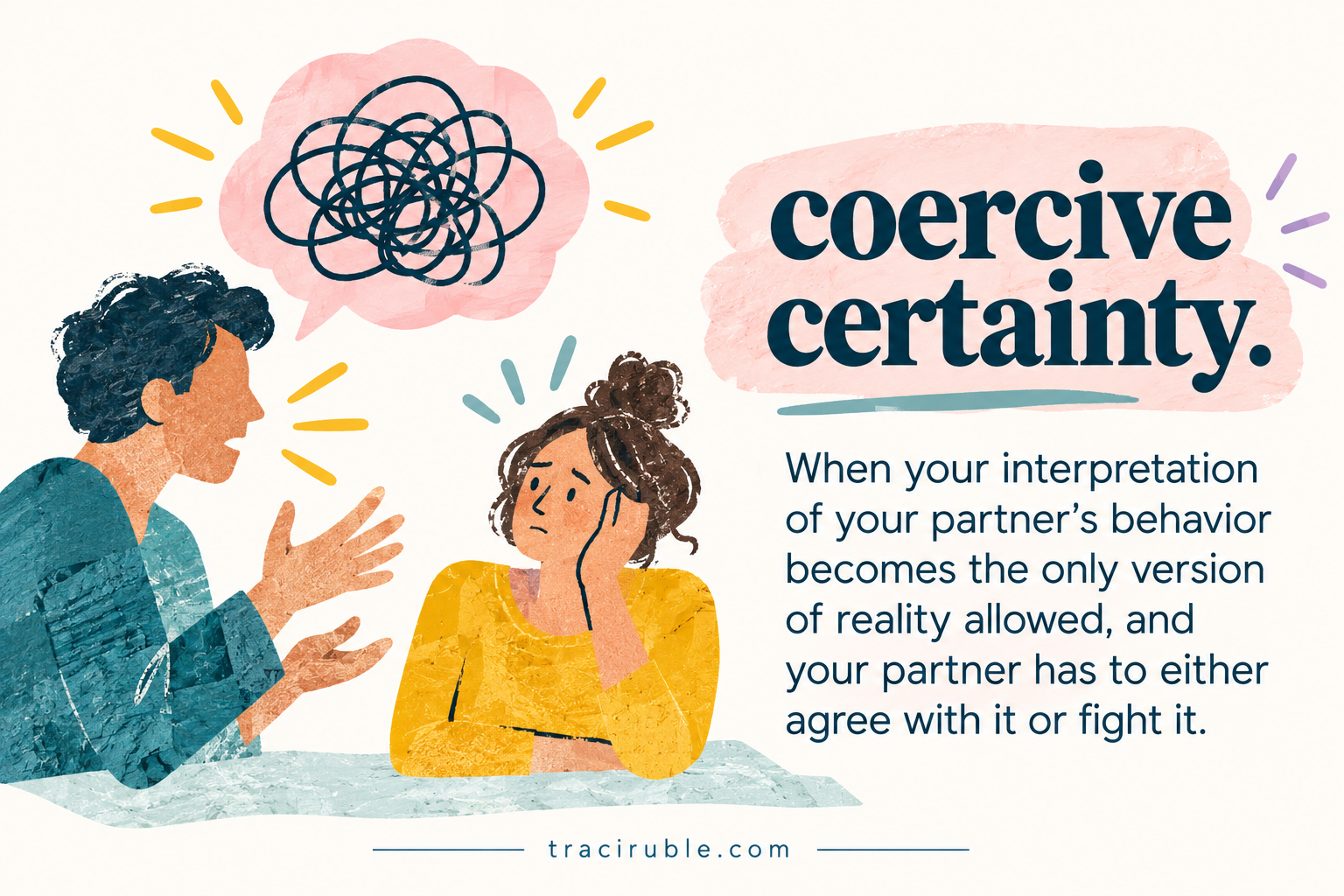
I call it coercive certainty. It's when your interpretation of your partner's behavior becomes the only version of reality allowed, and your partner has to either agree with it or fight it.
What starts the reaction, and then the conflict
Your partner furrows their brow.
They sigh.
They look at their phone while you're talking.
They sound irritated when they answer you.
They say, "Can we not do this right now?" with a tone.
Or maybe they really do lose their patience. Their voice gets sharp. They look exasperated. They say something badly.
And inside you, something happens very fast.
They're dismissing me.
They don't care.
Here we go again.
I'm not allowed to have needs.
They're trying to control me.
Nothing has changed.
I'm alone in this relationship.
Notice what just happened.
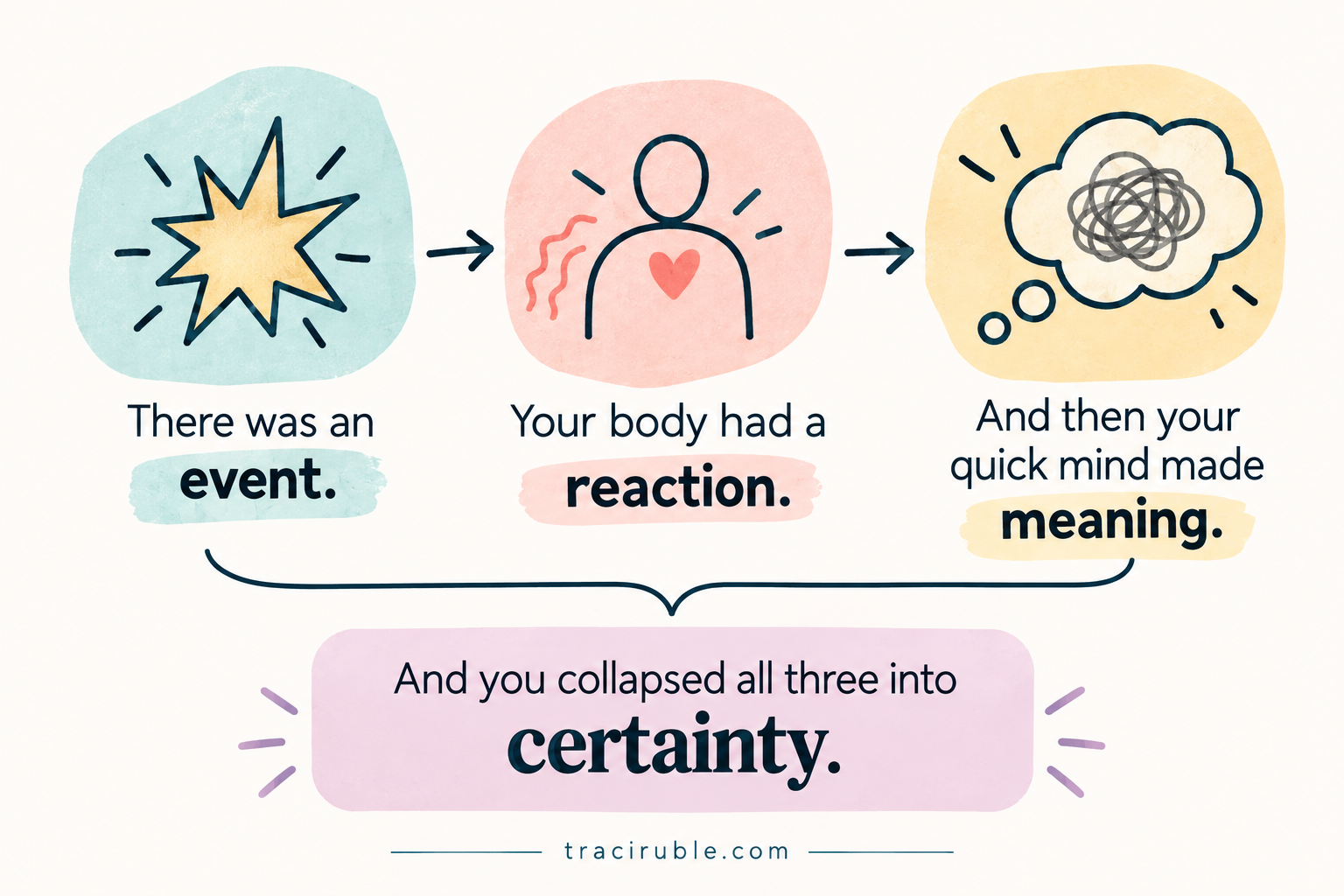
There was an event.
Your body had a reaction.
And then your quick mind made meaning.
I can understand how your mind got there, and there's likely a lot of validity to the story you're telling.
But those are still three different things: the thing that happened, your reaction to it, and the story you made up about it.
Here's the big problem in couples work that most couples don't know, so let me save you a lot of cash right now with this little lesson. Ready? Write this down. Or save my little graphic I made you on your phone. Better yet, I am making these new interactive html tools. Save this to your phone and use it ot practice.
When you get triggered, heightened, reactive, activated, outside your window of tolerance (call it whatever you want), your system collapses those three separate things, the event, the reaction, and the meaning, into one thing: certainty. The skill of being in relationship is keeping them separate.
Your brain is supposed to do this
Human beings are prediction-making creatures.
That means your partner's exasperated comment wasn't actually brand new to you. Our brains and nervous systems are constantly comparing what's happening now with what has happened before.
A facial expression. A tone of voice. A pause that lasts a little too long.
Your body can register something important before you've consciously thought anything at all.
Then your mind gets to work.
Oh. I know what this is.
If you've lived with someone for fifteen years, you probably do know quite a lot about their faces. I don’t doubt that.
The problem isn't that we make predictions.
The problem is what happens when the distance between what I experienced and what I'm certain I know about you disappears.
Something happens. The event.
Your body reacts.
Your mind makes meaning.
I'm repeating this so you really get it. Event, body reaction, brain meaning.
And suddenly:
I'm not having a subjective interpretation. I am the sole knower of the facts and what went down, they are not a knower.
Certainty feels really good when we feel threatened
Did you read that header? Certainty feels really good when we feel threatened. It's why polarization is in vogue, conspiracy theories are in vogue, and why we go hunting for facts that confirm what we're already certain of on the internet.
Certainty feels damn good. It organizes things. Makes them tidy inside our minds. It makes our bodies calm down. Even if that certainty is a bit rude about other people, or about ourselves.
If I'm scared and confused:
Oh. You're rejecting me.
Oh. I'm mentally ill.
(Now I kind of feel in control of what's happening - at least we trick ourselves into feeling that we are in control with all that certainty.)
If I'm hurt:
You're selfish.
I'm too sensitive.
If I'm ashamed:
You're criticizing me.
I'm weak.
If I'm afraid of losing you:
You're pulling away again.
I'm unlovable.
See how the mind takes a messy feeling about an interaction and turns it into a certainty narrative? And it can be hard on the other person or hard on you.
And again, you might be right about some stuff.
This isn't an exercise in gaslighting yourself. I don't want to gaslight you.
Sometimes your partner really is dismissing you. Sometimes that face means exactly what you think it means. Sometimes you've seen this movie 400 times.
But the way to know the difference is to pull apart the event, your reaction, and your meaning long enough to double-check. If you don't, your certainty mind can become a little authoritarian in your relationship, dictating which feelings and expressions are okay, with not much room for your partner to be known.
Now your partner has a problem
Imagine I become certain that the irritated look on your face means you don't care about my feelings or you intentionally want to hurt me.
A really healthy way to approach this would be to say:
"I saw your face change just now, and my mind immediately went to, 'You don't care what I'm saying.' Is that what's happening?"
But most couples don't say that. Oh lordy no.
Instead, they say:
"See. This is exactly what you always do. You don't care. How could you possibly care about me if you treat me that way?”
You just put your partner on an emotional tightrope with that statement.
They can either accept your description of them.
Or they'll fight like hell against your certainty so their experience doesn't get erased.
"That's not what happened."
"I do care."
"I made a face because I'm exhausted."
"I wasn't even thinking about you when I sighed."
What is worse is if I'm really certain, your fighting like hell to have a point of view in this conflict feels like proof I was right.
"See, you're defensive. That proves my point."
"You're gaslighting me."
"You never take responsibility."
Now we're no longer talking about the face.
We're fighting over who gets to define reality.
What your certainty does to your partner
People respond to that pressure of your certainty in different ways but do know, you do have an impact and they will behave accordingly.
Some people get smaller. They explain less, bring up fewer complaints, monitor their tone and facial expressions, and eventually decide it's easier not to say anything. They become an empty shell person. (Yes, I stole that line from the movie, Under The Tuscan Sun)
Other people get bigger. They argue the facts, correct the details, get louder or exasperated:
"That is NOT what happened."
"I said it ONCE."
"Will you please listen to what I'm actually saying?"
And now each person's reaction becomes evidence for the other.
"Look how angry you are."
"I'm angry because you aren't listening to me."
"See? I can't talk to you."
"I can't talk to YOU."
Some people shrink when there isn't enough room for their experience. Some fight harder to get their experience back into the room. Some of us do both.
That's what coercive certainty does to a relationship.
But aren't we supposed to communicate better?
Yes.
I teach communication skills.
Soft startups matter.
Timing matters.
Consent matters.
Tone matters.
If sarcasm, contempt, yelling, interrupting, or cruelty are your normal ways of communicating, learning another way is important.
But I sometimes worry we've turned "healthy communication" into another vigilant little superego policing our relationships.
No sharp tone.
No exasperated face.
No badly worded sentence.
No getting overwhelmed.
Everybody use their skills, spoken like a parent to a 3 year old who you are teaching to ‘use their words’.
Be perfect with your communication… All. The. Time.
Excuse me, have you met humans?
Sometimes your partner is going to be grumpy.
Sometimes they're going to make a face.
Sometimes someone who loves you is going to get exasperated.
Sometimes you're going to say something beautifully vulnerable and your partner is going to respond terribly because they haven't eaten lunch.
And sometimes a partner's messy outburst is a protest for not being able to get your attention for so long.
Please hear me.
Something isn't working.
I don't know how else to get your attention.
Their delivery, when they say messy stuff, may need work. Of course. Agreed.
But if we use psychology to police everything about our partner, we miss regular old human intimacy, and we miss hearing what got stirred up in them.
A healthy relationship needs communication skills.
And, it also needs partners sturdy enough to let each other be messy emotional beings.
So what do you actually do?
Slow way, way down. I say "low and slow" to my clients a lot. When in doubt, speak in a lower register at a slower pace.
Pick one fight.
What actually happened? (That's the event.)
"She sighed when I started talking."
What happened in my body? (That's the body reaction.)
"My chest tightened. I felt hot."
What did my mind make it mean?
"She's already annoyed with me. She doesn't want to hear what I have to say."
And then the really interesting question:
How certain am I that my interpretation is the whole truth?
Not whether your interpretation is stupid, or whether you’re allowed to feel it. I don’t want you to ignore your instincts here.
Just notice the certainty.
Because your certainty is often where your ability to let your partner have their own mind and feelings has gone missing. (This is called differentiation.)
Differentiation is not becoming a Zen robot
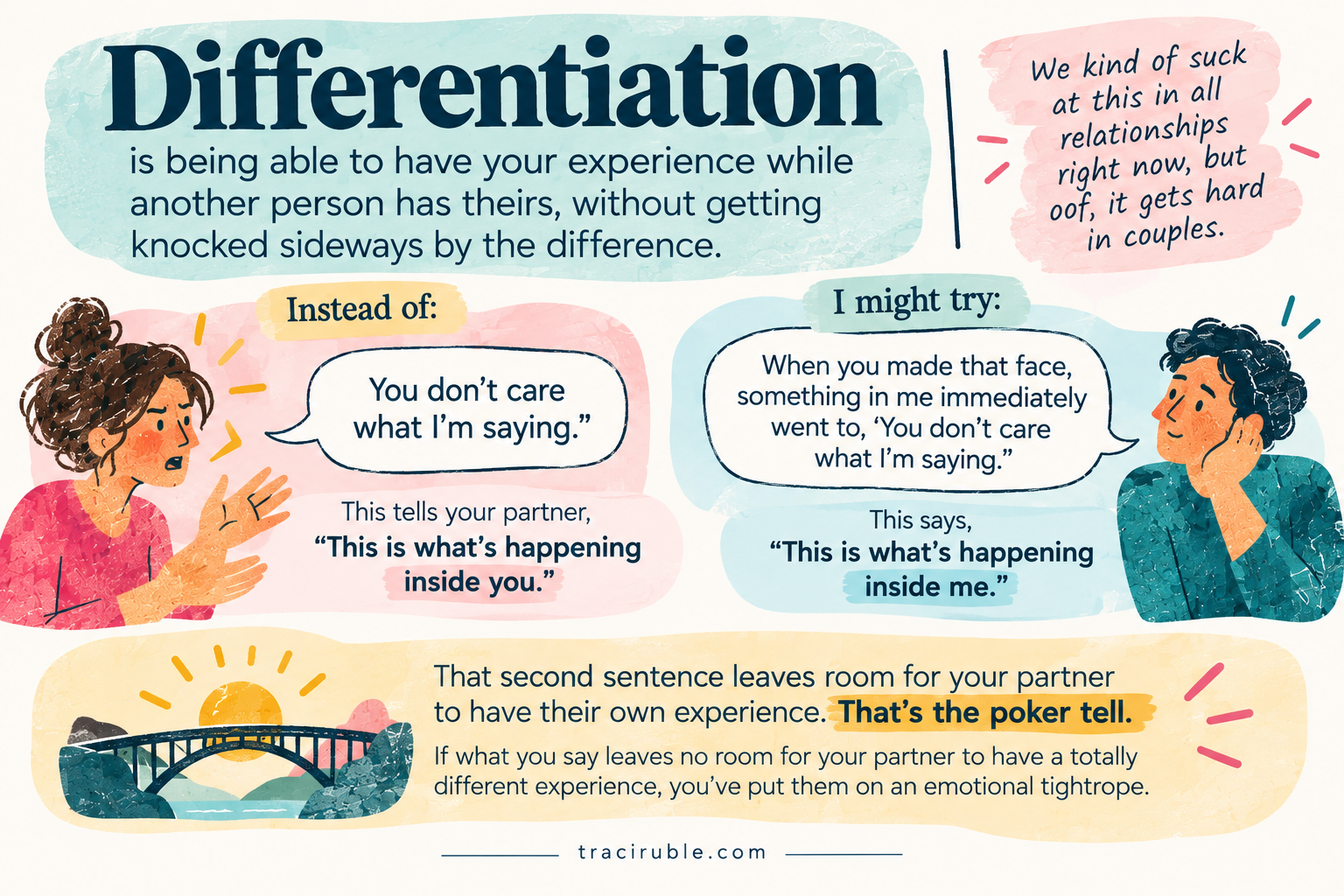
Differentiation is being able to have your experience while another person has theirs, without getting knocked sideways by the difference. We kind of suck at this in all relationships right now, but oof, it gets hard in couples.
Instead of:
"You don't care what I'm saying."
I might try:
"When you made that face, something in me immediately went to, 'You don't care what I'm saying.'"
How are those two different? Another place to take notes, folks.
The first sentence tells your partner, "This is what's happening inside you."
The second says, "This is what's happening inside me."
That second sentence leaves room for your partner to have their own experience. That's the poker tell. If what you say leaves no room for your partner to have a totally different experience, you've put them on an emotional tightrope.
And if you're on the receiving end of certainty?
Do you know what you tend to do when you're misunderstood, or told "you don't care what I'm saying" when that isn't what you feel?
Do you disappear?
Do you accommodate your partner's point of view?
Do you start monitoring yourself so you never upset your partner?
Do you get bigger, louder, and fight harder to be heard?
Do you become a lawyer trying to convince your partner?
Do you get so desperate to be heard that you start speaking with certainty too?
Navigating this "they said, they said" cycle makes up about a quarter of my work with couples.
Part of why I wrote this piece is it is so painful to watch it. Couples get so busy fighting over whose certainty wins that they both end up feeling erased and worse. This dynamic is why couples offten feel worse after a therapy session so I teach a lot a lot a lot of differention skills when folks are open to it.
And the awful thing is that each person's attempt not to be erased makes the other feel even more erased, because they're fighting from coercive certainty instead of being two differentiated humans sharing their experience.
That's a couple’s fight. That's my job every day.
You don't have to surrender to your certainty
Look, the goal isn't endless uncertainty. Watch how your mind might already be trying to turn this article into a certainty. If you're doing that, sit with that certainty-hunting part of your mind with some compassion for a minute.
And again, your read of the situation may be right on the money. Hear that, please.
This isn't about taking that away. It's a practice that grows your capacity to relate in a new way. So try saying these things to yourself right now and notice how they feel.
I can trust what I see without climbing inside your mind and telling you how you feel.
I can tell you what happened to me without requiring you to agree with my interpretation.
I can hear that my behavior affected you without agreeing with everything you say about me.
I can be irritated, messy, hurt, or exasperated without making my emotional state a final judgment about who you are.
I can tolerate that two people who love each other may experience the same moment very differently.That's not perfect communication.
That's differentiation.
Two messy humans, two nervous systems, two minds.
Both sharing, and both listening to how the other is experiencing this moment - or at least that is the goal in our sessions together.