
What Are We Asking Marriage to Do?
A couples therapist on learning to love, inherited roles, and what we might build together
By Traci Ruble, LMFT, couples therapist with 23+ years of practice.
October, 2026
I recently read a piece by Avalon, a prolific Substack writer, with the clickbait-y title Why I’m No Longer a Fan of Esther Perel. After describing how her life opened up when she left her marriage, she asks: if Esther Perel’s work tells us we expect too much from marriage, why pour so much energy into making your marriage better?
I wrote a comment on her article. Then I realized I wanted to expand on it and wrote this. Because I have a concrete response to her query while also honoring, for her, marriage was deadening. My point is not exactly about marriage and more about how we learn to love.
Here’s my stance: marriage is one of the best places we have to learn how to love as adults.
That’s a funny thing for me to say. I’m the queen of not taking a stance. And after watching my parents marry six times, I was pretty sure I never wanted to get married. Then I realized, “Oh, you can co-create a marriage under new terms, so long as you find someone who wants to co-create it with you.” I did. And we go to couples therapy to keep growing because, like you, we fight, we love, we laugh hard, and we ponder what marriage is for. He loves listening to my books on the history of marriage on long car rides.
I’m not a marriage zealot. I have supported folks who are open and poly, and I hope marriage keeps expanding to allow more love. But the institution has reinvented itself so many times over thousands of years that something in it seems worth keeping for folks, clearly. And right now, my god, it’s a place to learn the skills of love and unlearn 1950s social norms, if we want to.
What we learn in love ripples out. When two people get intentional about care, power, responsibility, and freedom, they change the world they live in. I think that’s revolutionary, and so you folks who work on your marriage, thank you for making the world better.
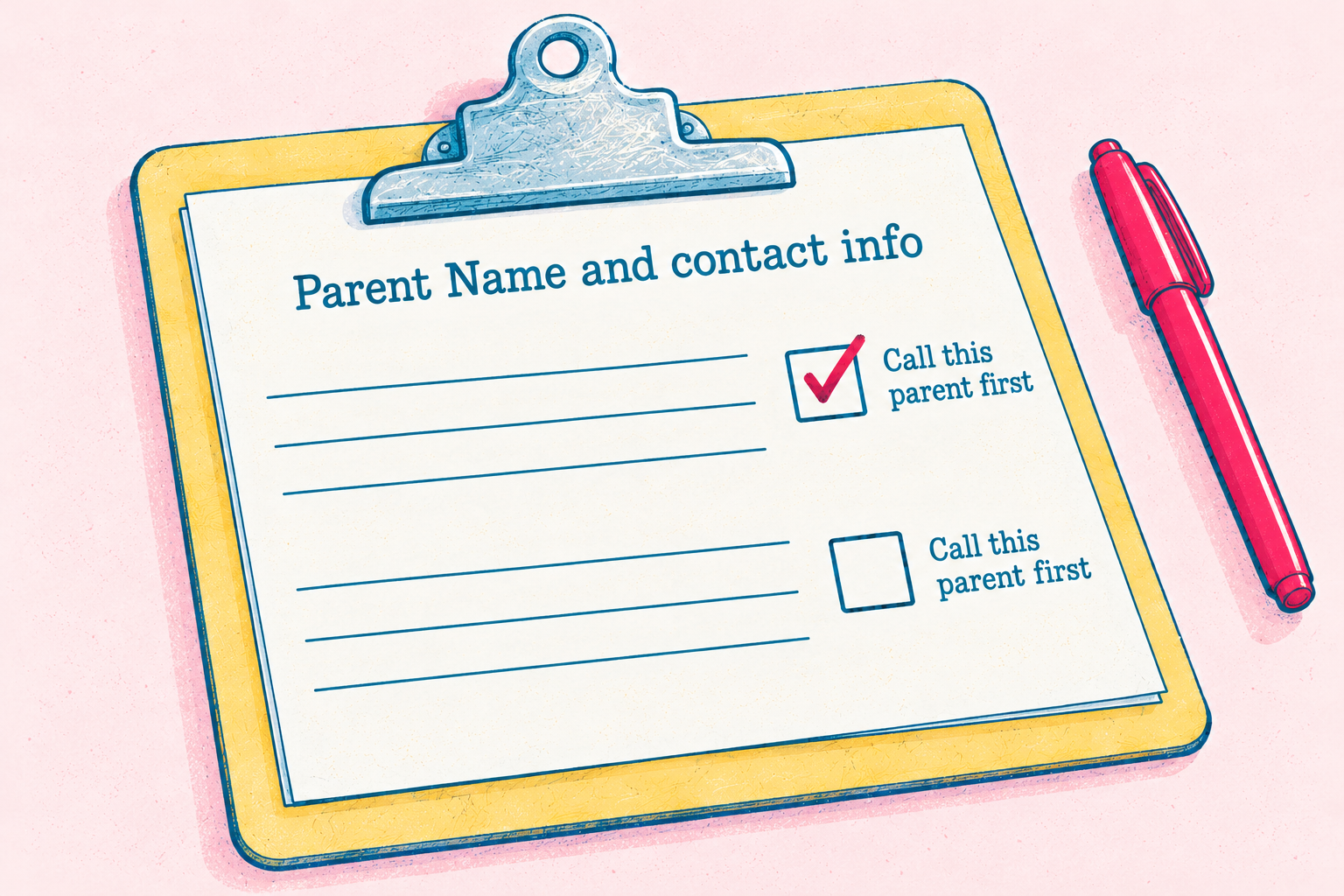
A small example about inherited structure of marriage. The secretaries at my kids’ elementary school could not understand why I didn’t want to be the first number they called when a kid had an accident. I asked them how often they assume it’s the woman they should call. What do they do with gay couples? They all scratched their heads. Their database had two slots for parents’ numbers, and the secretary called the female-sounding name. It needed a box that says “call this person first.”
I hold myself to one question as a couples therapist: am I helping people build loving relationships, or helping them endure? Some of my clients are enduring, for the kids or because they can’t afford a divorce, and I follow their lead.
But you aren’t my client, dear reader, so I can be more full-frontal and bossy with you? Build your relationship. It won’t be easy. It will involve grieving that every human you build a life with will let you down and come with shortcomings and baggage. But if you're both up for building and learning to stand in love, that is noble. When you co-create a new structure for your relationship, you help change the structures around us.
Learning to love one person, learning to love the world
Here’s where I ruin the fairy tale we all inherited from the 1950’s.
Erich Fromm says we don’t fall in love. We stand in it. In The Art of Loving, he argues that we confuse the rush of falling in love, that crazy-about-each-other phase, with the ongoing state of being in love. He even suggests the intensity of an infatuation may say less about how much we love someone and more about how lonely we were before we met them. Ouch.
Falling happens to you. Standing is something you do, over and over, on purpose. The fairy tale skips that part because it’s not very cinematic.
So no, it won’t look like some Ryan Gosling meets Kate Hudson rom-com where everything is an adventure and falls into place. It will look more like Kate and Hal Wyler in The Diplomat.
Fromm also writes, “If I truly love one person I love all persons, I love the world, I love life.” For him, love is a capacity you build through practice, and marriage is one of those 24-hour gym memberships. When I learn to stay curious about someone who’s totally different from me, to show care without becoming controlling, to respond to their needs without becoming a doormat, I’m building muscles I’ll use everywhere else.
Can you build them in friendship, family, community, and your nation? Of course. The nuclear family isn’t sacred to me. But the people in my office chose marriage, straight and queer, and they came for help with the one they’re in. So that’s where I work, and the question I bring is: what are you two building?
How inherited gender roles shape marriage
My nerdy side hobby is reading Stephanie Coontz on the history of marriage. This is the author my husband likes to listen to on long car rides. Her work is so fascinating and historical. It is wild to learn how marriage has organized labor, property, children, political alliances, and belonging in a hundred different ways. Once you read up on how marriage has changed across cultures and over time, the version we have right now doesn’t look so inevitable. People built it then. People can build something else now. It just takes some grit, courage, relating skills, and creativity.
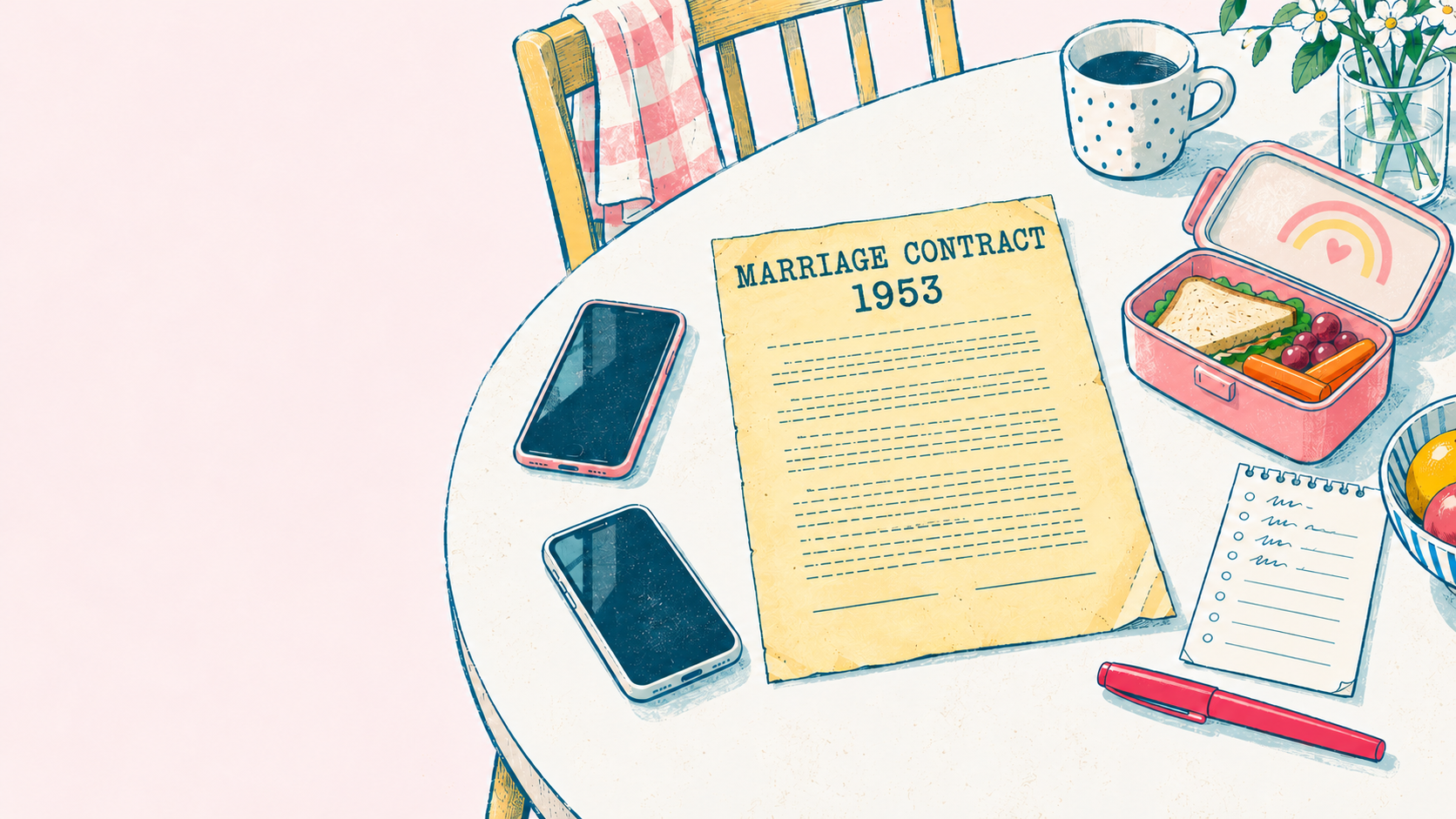
When couples don’t get intentional, though, the inherited arrangement decides for them. In heterosexual marriages, that usually means patriarchy quietly running the household: whay work gets noticed, what time gets protected, who has authority, who adjusts. Queer couples aren’t exempt. They grew up in the same culture. My chin hits the floor when I see some of the same power struggles show up for them too.
Then everyone spends years irritated, locked into a contract nobody read before signing. One person keeps asking for connection. The other hears that ask as criticism. One person asks for sex. The other hears that ask as unfair. Same fight, different night, and nobody sees that the damn contract they signed was written in 1953.
The impact of that old contract is usually hiding in really boring places. Who calls the school? Who notices you’ve stopped having fun? Who gets to make plans assuming the other one has the kids? Whose life dissatisfaction gets attention and energy, and whose doesn’t?
I think marriage is where we can start dismantling patriarchy, one negotiated chore chart at a time. Two people who examine how power works between them and practice sharing it in creative ways end up raising kids differently (if they have them), tending friendships, and contributing to community in ways that change those relationships too.
The person asking for change is often already furious
“Let’s explore this together” sounds like a very just and inclusive thing to say. But here’s the real scoop: the labor of getting the couple to explore their relationship often falls to the female partner. Not always. I have some of the most heart-forward men in my practice, tbh.
In my recent Schema Therapy training for couples, the point was made that women in heterosexual couples usually do the noticing, naming, and tending of the relationship. By the time she says, “We need help,” she’s often already pretty pissed off. Her anger isn’t the problem. She hasn’t been heard for years.
So she doesn’t want to design a new plan for how to connect and share the load and then sell her partner on it in couples therapy. She’s too pissed off.
Here’s my bind. If I scold a man for what his socialization made easy not to see, I get shame, defensiveness, or a guy staring at the carpet. Then she gets one more job: managing his withdrawal. That’s not justice and it’s not good therapy.
So I name the inequality without making her prove it or teach it. I expect him to step up and grow the capacity to listen to her anger, and for her to grow the capacity to befriend her anger and use it to schemize a new agreement between them. It takes time. Both nervous systems are defended so we have to move them out of that cycle of blame/defend interaction. And I watch for whether both people are safe. Where there’s coercion or fear, “mutual exploration” is a cover story, and I won’t run that play.
I get this wrong sometimes. I fuck it up and have to repair it in the room. That’s part of the job.
Carol Gilligan and Naomi Snider’s Why Does Patriarchy Persist? helps me see the psychological grip of these patterns, alongside the perks they hand out. Inherited roles cost men and women. It sucks. I’ve had men secretly wishing to be stay-at-home parents who felt it wasn’t OK to want that. And women who felt like “bad moms” for starting companies. These stuck roles cost both, but not equally. We have to tell the truth about that, hold that grief together, and decide together what to do now.
What are we building together?
Most couples come in wanting to stop having the same fight. Great reason. That is why I go to couples therapy. Nobody walks in saying, “We’d like to interrogate the institution of marriage,” and most therapy stops once the fight resolves. But I do have some couples who want to go further, and I follow their goals. Me and my husband ask about it too.
Because look, a fight about dishes is almost never about dishes. It’s about what this partnership is for. What each of you gets to count on. Which responsibilities you chose and which landed on you by default. What happens when the deal stops working for one of you? Do you know how many women I know with huge jobs, C-suites even, who still do the larger share of house management, meal planning, and groceries? I haven’t run the numbers, but in my circle it’s nearly all of them.
Stan Tatkin’s work gives a solid starting point for the “building something” idea: shared purpose, shared authority, explicit agreements grounded in fairness. Then those principles have to show up as behavior. “We’re a team” means nothing unless you’ve built in accountability.
Lots of couples get stuck keeping score: I did this, you owe me that. It robs us of the pleasure of generosity when we do that. Real love isn’t a tally sheet. At the exact same time, unequal giving needs to be seen. The way past this blame thing is that a couple needs a purpose and vision big enough that every act of care doesn’t come with $20 on the bedside table or a blow job.
Fromm names four elements of love: care, responsibility, respect, and knowledge. You need all four elements or your love does turn into the BJ’s and twenties on the table. Responsibility without respect turns into control. Care without knowledge of the real person is just you caring in a way that makes you feel good. So the questions get sharper. Does my care help you grow? Did I ask what you need? Can I accept that your life might go somewhere I don’t get control over?
Your partner has been shaped. So have you.
Nobody stirs up old hopes and fears about love like a partner. We want them to see us, choose us, stay, and maybe give us what we didn’t get growing up. Those longings are so tender and even biological. And they’re under some of our fights about the dishes too.
Marriage can be such a wonderful place to do healing work around relationship injuries from childhood. But it can’t heal everything, and handing your spouse the bill for your whole childhood is a recipe for resentment on both sides. Some models of couples therapy irritate me because, imho, they lean too heavily on “this marriage has to make up for childhood (or patriarchy).” A marriage does have to accept how each partner was shaped. But our partners don’t reparent us, even if we secretly long to return to that warm symbiosis of early motherly love. Our partnerships are safe, reliable, adult-to-adult relationships.
You and your partner may need to do your own growth work to be in adult-mode more of the time and that is fine. At the same time, you will need to accept you were both shaped by a life you don’t just get over. It takes mad skills to love a human in all their complexities. And that is facts.
Schema therapy for couples is one way I track the past showing up in the present. A schema is an old expectation, like “my needs won’t matter” or “closeness ends in rejection.” A mode is what I turn into when it gets triggered: I attack, I cave, or I go dark. My mode sets off yours. Yours sets off mine.
Once you can see the cycle, like how your attack makes them go dark, you can interrupt it and try to communicate in ways that get you both what you need. Some folks balk at this bit. “That isn’t authentic.” I work with them on accepting what it means to relate to a different human, and that yes, we do adjust to the person in front of us. That isn’t an attempt to stifle authenticity; it is adult relating.
Being able to ask questions like: What happened for you? What did I decide it meant/what did they decide it meant? What am I feeling and needing/what are they feeling and needing? What did I do, and how did it land on the other person? What might be going on for you that I haven’t checked? “Unbridled authenticity or expression,” as Terry Real calls it, “the barf bag” of communication, is usually a sign the person is in a child part, not an adult part. And the work for the couple is how to lovingly invite one another into healthy adult modes over and over and over again.
Adverse experiences when we were young commingle with other elements of present reality. An unequal workload is an unequal workload, even when it pokes something painful from the past. Just because both people are in the pattern doesn’t mean they have equal power to change it or do equal harm to one another. You see how complex this is?
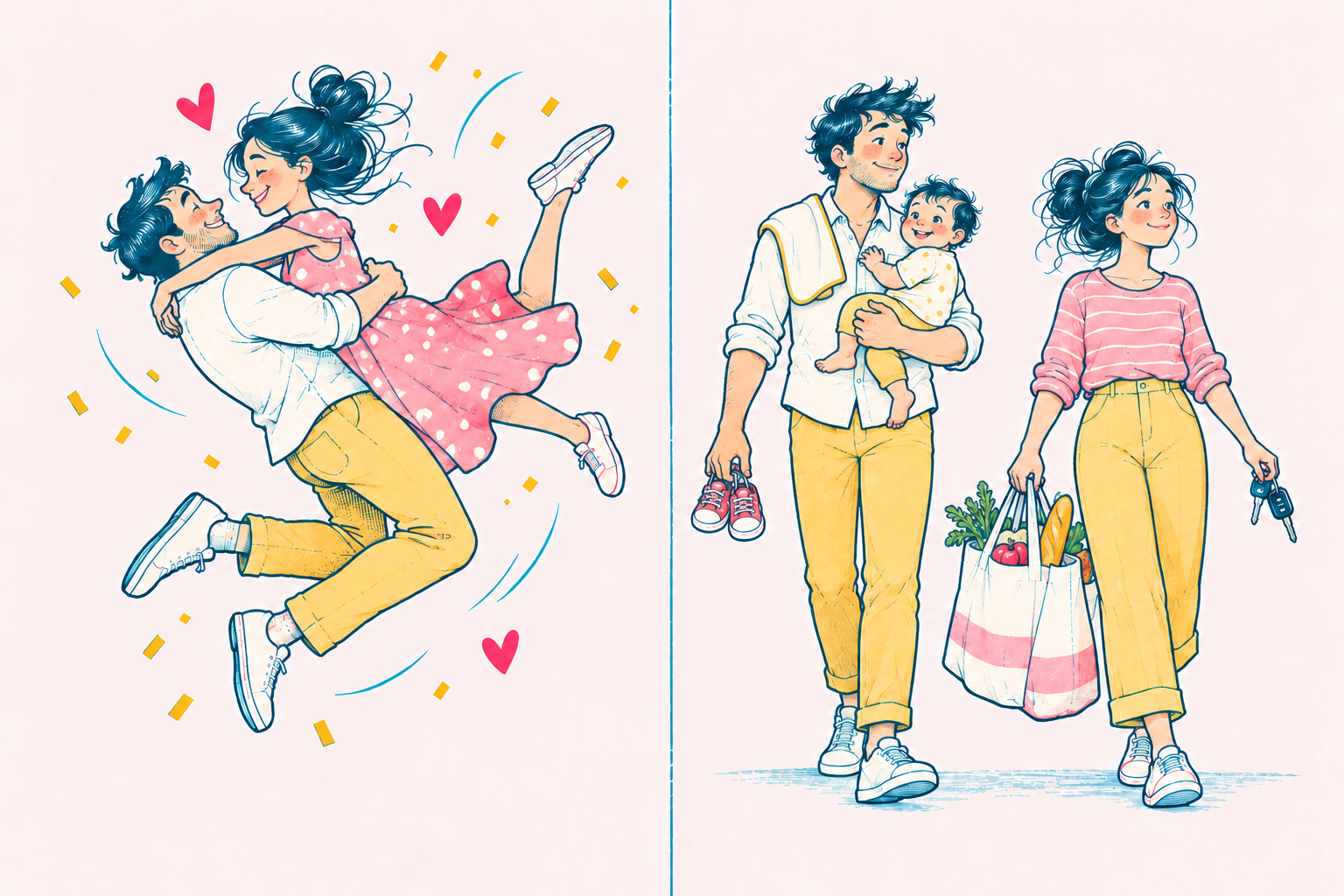
A marriage needs a world around it
We’ve turned the couple into a companion, a nurse, a financial plan, a co-parent, a lover, a community, and the meaning of life. Meanwhile, friendships and extended family have thinned out, often because of moves, work, money, or caregiving.
No marriage can carry all that. That was Esther’s point, and Avalon’s. So why work on it?
Because part of designing a marriage is creating your life, meaning, and contribution outside it. Who else knows you? Where do you contribute to others? Who helps raise your kids? Which friendships need tending? A good marriage belongs to something bigger than itself. You can build that into your plan, you see.
Avalon writes powerfully about desire coming back into her body when she stopped playing the “good wife.” I see that awakening in my office all the time, and I’m for whichever choice lets both people stay fully alive. Sometimes that means leaving. More often than people expect, it means rewriting the terms and staying. I lean toward rewriting, partly because I see what a new vision for marriage does for the world around the couple, and partly because of who usually makes the call. Most of the leaving I see happens from child-to-child or child-to-adult relating. Two people deciding to end things after getting fully into adult-to-adult relating happens rarely, and when it does, I respect it deeply. Ending a relationship from a child mode, frankly, bums me out. Because it is likely they will go on to repeat that dynamic in their next relationship. The child modes are sticky ones.
That’s where duty and desire come in. Both have a place in love. When duty asks someone to lose their sparkle to the role of wife or husband, I push back for sure and see what we can build to keep sparkle alive. When desire shows up and wants to throw all duty out the window, I get curious about what it’s saying, and which part of you is saying it, before anyone impulsively follows it. I do a lot of parts work with all of this.
Why I like marriage counseling
I help people get intentional about the life they’re making together: choosing the terms, practicing how to love, and catching the patterns that drag them off course. I stay honest about what both people are willing and able to change, and about what the relationship makes possible for each of them. Where love won’t be perfect we hold grief well together because acceptance and grief are intimate.
I believe all this work, unlike Avalon’s point of view, is worth the effort because learning to love one person changes how we meet everyone else. Sharing power at home changes how we share power everywhere. Caring, being responsibe for, respecting, and knowing deeply another human allows us to take those values out to our larger community. A couple can build something that makes both of them more alive and more able to care about the world.
That’s why I keep doing marriage counseling. Not because marriage is sacred, but because it’s one of the best classrooms for love we’ve got.
One caveat the impact of political, religious, social and economic structures on marriage is real and is missing from this piece. It would have made it really long but are also impacing partnership. Sometimes those structures, or lack of structure, also impact whether “doing the work” is possible. I don’t want to deny that. Who has time to talk about marriage satisfaction when you can’t pay to live. That is real too. I see you.
FAQs
Why work on a marriage if it carries too much?
Because marriage is one of the best places to practice loving someone up close, and what couples learn about sharing power and care spreads into work, school, and community.
What did Erich Fromm mean by standing in love?
Fromm argued we confuse the rush of falling in love with the ongoing practice of love. Falling happens to you. Standing in love is something you choose and practice.
How does patriarchy show up in modern marriages?
Usually in ordinary places: who calls the school, who plans meals, whose time gets protected, who adjusts. Couples can notice these patterns and renegotiate them on purpose.
Is leaving a marriage ever the right choice?
Yes. But most leaving happens when both people are reacting from old, younger parts of themselves. Ending things after relating adult to adult is rarer and more trustworthy.
Is this article against open or non-traditional relationships?
No. The argument is about intentional partnership, including open, poly, and queer relationships.
Try the tool: How to Build a Loving Marriage That Isn’t Stuck in the 1950s is a free interactive practice for couples who want to rewrite the deal on purpose. [Link, live Friday]
About Traci: Traci Ruble, LMFT, is a California-licensed Marriage and Family Therapist and international relationship coach with 23+ years of clinical experience. She works with high-conflict couples, executives, founders, and expats in Europe. She founded Sidewalk Talk and runs the Mischief Lab.
Work with me: Couples therapy, coaching, and couples intensives. Learn more
Get the new writing and tools: New essays, free tools, and Mischief Lab events.
This article is for education, not a substitute for therapy. If you’re in a relationship where you feel unsafe, contact a local domestic violence hotline or emergency services.