
Your Family Holiday SOS Plan: This Year Can Be Better
The holidays are a season of warmth, tradition, and togetherness—or at least, that’s the Hallmark version. You likely already know that family gatherings stir up our insides and have us revisit past hurts in ways we would rather not. It’s no wonder we sometimes leave these gatherings feeling drained, frustrated, or misunderstood. And every year my practice gets busy around this time. Old clients pop in for a tune-up. Smart folks with big leadership jobs are chagrin at how being with family reduces them to tantruming or rebellious teenagers. “Why do they get the better of me?” they ask me in session.
I wrote this for everyone who wants this year to be different. As a therapist for over twenty years and a human who loses my grip around family, too, I’ve seen how small shifts in awareness and behavior can transform family gatherings. You can foster genuine connection and reduce conflict by staying grounded, stepping out of rigid roles, and approaching differences with curiosity. Note: I put the tips in cliff notes at the bottom so you can screenshot them and carry them around. I genuinely want you to feel supported around this group of people who would likely have your back in a Hunger Games contest more than other humans.
1. Getting Out of the Role Your Family Sucks You Into
Family gatherings seduce us like no other group we will ever be a part of to return to the old roles we played for that group. Just say no to the old role you played in your family when you were young, and you will have a better time during the holidays. That or your family will be confused and think you are weird but they will be so stunned it will be more entertaining. Alternatively, fully play your old role but on your terms with your conscious consent instead of feeling roped into it. Be “The Hero” or “The Helper” by choice. Either way, your family will probably notice the vibe shift and things will likely be easier.
Bad news: changing roles is easier said than done. Roles like "The Golden Child," "The Scapegoat," or "The Peacemaker" resurface, trapping us in dynamics that no longer serve us. Why do family systems give people unconscious roles? The short answer is to protect the family system from instability and ensure survival. These roles form unconsciously as families try to maintain balance and avoid deeper conflicts. While they might provide temporary stability, they can fuel relational resentment, disconnection, and recurring tensions. This is all rooted in family systems theory. Folks like Virginia Satir, Claudia Black, and Murray Bowen. If you want books to read check out Virginia Satir's oldie but goodie, "The New Peoplemaking" or Claudia Black's "It Will Never Happen to Me", which discuss family roles in greater depth.
A very Traci Ruble role-play. Sometimes I need to work on shifting a role. So what do I do? I play. I am a naturally playful human and find leaning into play helps this whole thing feel a lot less high stakes. I just put on the costume of another role or character (one that is further away from the Rebel or Scapegoat grouping) and play the act. I like being The Clown or sometimes The Peacemaker or Helper. Make up your own role. Be Santa Claus or The Family Dog. I am giggling, imagining you and me as Santa. You catch my drift.

Common Family Roles and How to Shift Them
The Hero (The Overachiever)
What The Role Is For: To bring pride and stability to the family by excelling.
How To Shift The Role: Let yourself relax. Say, “I don’t have all the answers, but I’m here to enjoy being with everyone today.” Vulnerability can deepen connection.
The Scapegoat (The Problem Child)
What The Role Is For: To divert attention from deeper family issues by being the “identified problem.”
How To Shift The Role: Refuse the blame game. Respond calmly: “I’m not going to take this personally. Let’s talk about what’s really going on.”
The Peacemaker (The Mediator)
What The Role Is For: To diffuse conflict and keep the family functioning.
How To Shift The Role: Let others hold their emotions. Step back and trust: “I know you two can work this out.”
The Rebel (The Nonconformist)
What The Role Is For: To challenge family norms or distract from dysfunction.
How To Shift The Role: Choose connection over defiance. Instead of reacting, ask, “What’s meaningful to you about that?”
5. The Golden Child (The Favorite)
What The Role Is For: To validate the family’s worth.
How To Shift The Role: Be real. Share your imperfections with humor: “I burned dinner last week—so much for being perfect!”
6. The Caregiver (The Helper)
What The Role Is For: To nurture and support, often at their own expense.
How To Shift The Role: Ask for help. Say, “Can we split the work? I’d love a hand.”
7. The Quiet One (The Invisible Child)
What The Role Is For: To stay out of the way and avoid conflict.
How To Shift The Role: Speak up. Share a thought or story: “I’d love to tell you about something exciting this year.”
8. The Comic (The Clown)
What The Role Is For: To ease tension and distract from conflict.
How To Shift The Role: Be present, not performative. Instead of deflecting with humor, say, “It’s okay to have hard conversations. I’m here for this.”
2. Managing Your Triggers Around Family
Our bodies are wired for survival, which means family conflict can easily activate our “fight, flight, freeze, or fawn” responses. Even a mild disagreement about bedtime routines or traditions can feel threatening, making calm, thoughtful conversation difficult.
A Trauma-Informed Approach with Internal Family Systems (IFS)
Internal Family Systems (IFS) helps us understand these defensive reactions as parts of ourselves trying to protect us. When a family member’s comment feels triggering, you might notice a defensive part rising up—perhaps anger, people-pleasing, or shutting down.
How to Care for Protective Parts:
Name the Part: Identify the part that’s reacting, e.g., “This is my angry part trying to protect me.”
Offer Compassion and Gratitude: Acknowledge its good intentions: “Thank you for trying to keep me safe. I’m okay right now.”
Ask What It Needs: Gently inquire, “What are you trying to protect me from? What would help you feel calmer?”
Recognizing and caring for your inner protectors creates space to respond thoughtfully instead of reactively.
Other Calming Trigger Strategies:
Pause Before Reacting: Take a few deep breaths or excuse yourself for a moment to reset. Cold water on the face in the bathroom is a good one.
Engage Your Body: Ground yourself by planting your feet firmly, wiggling your toes, putting on a coat or sweater and feeling its heft against your skin, or holding a warm cup of tea.
Be Curious and Listen: Ask open-ended questions like, “What’s been meaningful to you this year?” Curiosity and listening to others can distract you from what is pissing you off or freaking you out.
3. Letting Go of Taking Shit Personally
One of the biggest challenges during the holidays is managing differences in values, whether about parenting, religion, politics or lifestyle choices. These differences can feel personal, even if they’re not intended that way.

Strategies for Bridging Differences:
Assume Positive Intent: Most family members aren’t trying to criticize you—they’re sharing from their own perspective. Start by assuming they mean well.
Ask, Don’t Tell: Instead of asserting your opinion, ask questions like, “What works for you?” or “What’s been most meaningful about that for you?”
Make Gentle Requests: If a conversation gets too heated, say, “I appreciate your perspective, but I’d like to focus on enjoying our time together.”
Take Boundaried Action: Remember boundaries are actions we take when requests aren’t honored (article I wrote here). So if the topic of conversation doesn’t change, politely get up from the table or take a walk.
Story: Parenting Style Differences
A client of mine (info/identity altered, of course) once shared how her brother criticized her screen-time rules during a holiday meal. Instead of getting defensive, she calmly said, “I can see this is important to you. Here’s why this works for us. I’d love to hear what’s been working for your family.” This shifted the conversation from judgment to shared experiences, deepening their connection.
4. Communicating Skillfully (rather than from triggers and roles mentioned above)
While politics or lifestyle debates aren’t always the centerpiece of family gatherings, they can quickly derail the mood if tensions rise. Sometimes, the issue isn’t what we believe—it’s how we communicate.
When the Problem Is Us:
Are You Listening to Understand? If you’re already planning your rebuttal while the other person is talking, you’re not really listening. Try pausing and saying, “I hadn’t thought about it that way. Tell me more.”
Are You Preaching or Connecting? Sharing your perspective is different from trying to convert someone to your side. Shift from “You’re wrong” to “Here’s how I see it—what’s your take?”
Are You Adding Heat? If things escalate, say, “I care about you too much to argue right now. Let’s focus on what we love about being together.”
Story: Choosing Connection Over Confrontation
One year, a client told me her sister made a political comment she deeply disagreed with. Instead of jumping in, she said, “I can see this is really important to you. I’d love to talk about it another time, but right now, I want to enjoy being here together.” This simple choice to de-escalate preserved their connection.
5. A Final Word on Staying Loving
The holidays don’t have to be perfect, but they can be meaningful. By stepping out of rigid roles, caring for your inner protective parts, approaching differences with curiosity, and communicating skillfully, you create space for authentic connection.
This holiday season, let’s prioritize love over rigidity, understanding over defensiveness, and connection over conflict. You might be surprised by how much warmth and joy you find when you do.
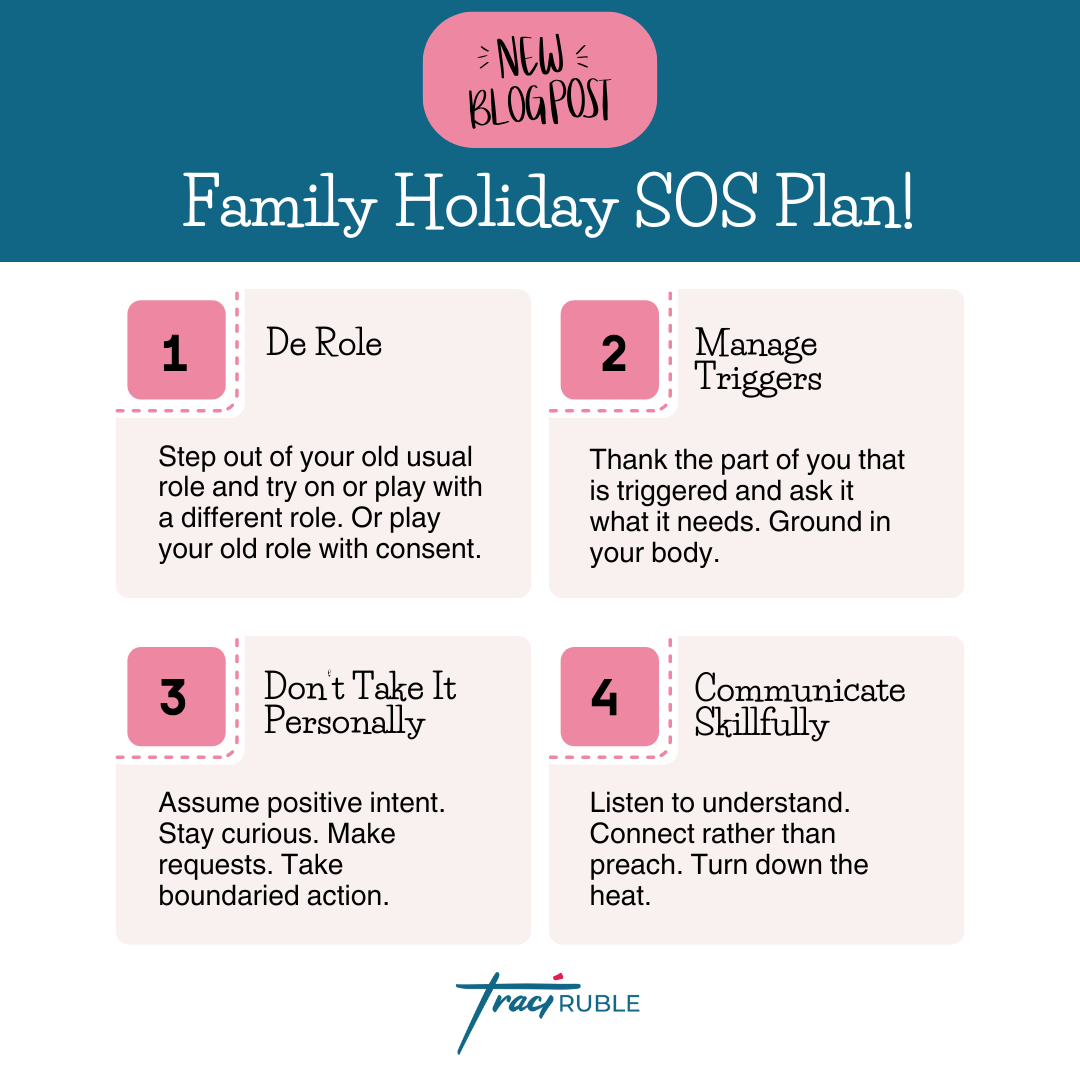
Screenshot this and carry it with you in your phone if you like as your mini SOS plan.