
Is My Calling Or Leadership a Trauma Response and/or Coping Strategy?

When leadership, hustle, or the need to help becomes your identity, it can be hard to tell what’s real. Here’s how to listen for what’s truly yours.
“When we don’t feel wanted, we make damn sure we’re needed.”. -Gabor Maté
Oof. That Gabor Maté quote lands hard for anyone who has built a life around being of service or being in charge. Here are some video tips from Gabor Maté on working with some of this material. Leaders, founders, therapists, activists… I have worked with them all, and I am one. Do more, hustle, be big, create, serve, give back (and then sometimes burn out, get resentful, have a heart attack). Ambitious people - you know who you are...you are driven, creative, and high-functioning, but secretly organizing your life around “being essential” sometimes to protect you from some traumatic beliefs about yourself. I have been confronting this one hard in my own system because I have a calling but it has tipped its toes into over-giving many times and I have zero interest in living my life in service of some old trauma pattern. And I work with a lot of leaders and founders, and for some, there is the same edge they walk of "calling," "scaling," and being a "founder" mixed with something else. A kind of traumatic nervous system survival response hiding out in their hustle.
Whether you're a founder, leader, therapist, or creative trying to make a difference, I hope we can dig in and explore some bigger questions:
Am I here because this is truly my calling?
Or… am I here because being needed is the safest way I know to belong?
This last question rarely comes up when you’re just getting started. It arrives later when the thing you built begins to feel like a cage, even though it once served you. So how do you tell the difference?
Before we launch in together, can we both agree you are going to read this piece with a sense of compassion and good humor? When I started looking at this stuff in myself I used it as little "shame" whip. We all have wounds and trauma. It is just part of being human. Let's keep it light and kind and loving and just accept, as my brilliant friend Ali reminds me "Humaning is just weird and hard". So read this without diagnosing.
I would sing this little song to you the whole time you are reading this....
This isn’t proof you got it wrong,
It’s just a softer, wiser song.
Trauma and Calling Can Wear the Same Outfit
Here’s the hard part that I am learning: trauma patterns and soulful purpose can look almost identical on the surface.
They both come with urgency.
They both can involve serving others or hustling a lot for the company.
They both can fuel ambition, creativity, and dedication.
But they feel different. And they leave different residue in your body and your spirit. So we will use that info as our guide to hear this new song, yeah? I have started to slow waaaayyyy down now and say to myself “Sweetheart, I love you. You are enough. You are safe. You are loved. You do not have to earn your right to be alive.” and then usually my body starts lapping those words up. I can then truly hear if it is calling or trauma in my system. It can still be hard to do that because sometimes the rushy urgent residue of trauma can feel electrifying, but I have learned over the long term that it is more like electrocution. So it’s good to practice some really good discernment so we can all live our call, yeah?
Here’s a little cheat diagram you can print out or save to your phone to remember how to tell them apart:
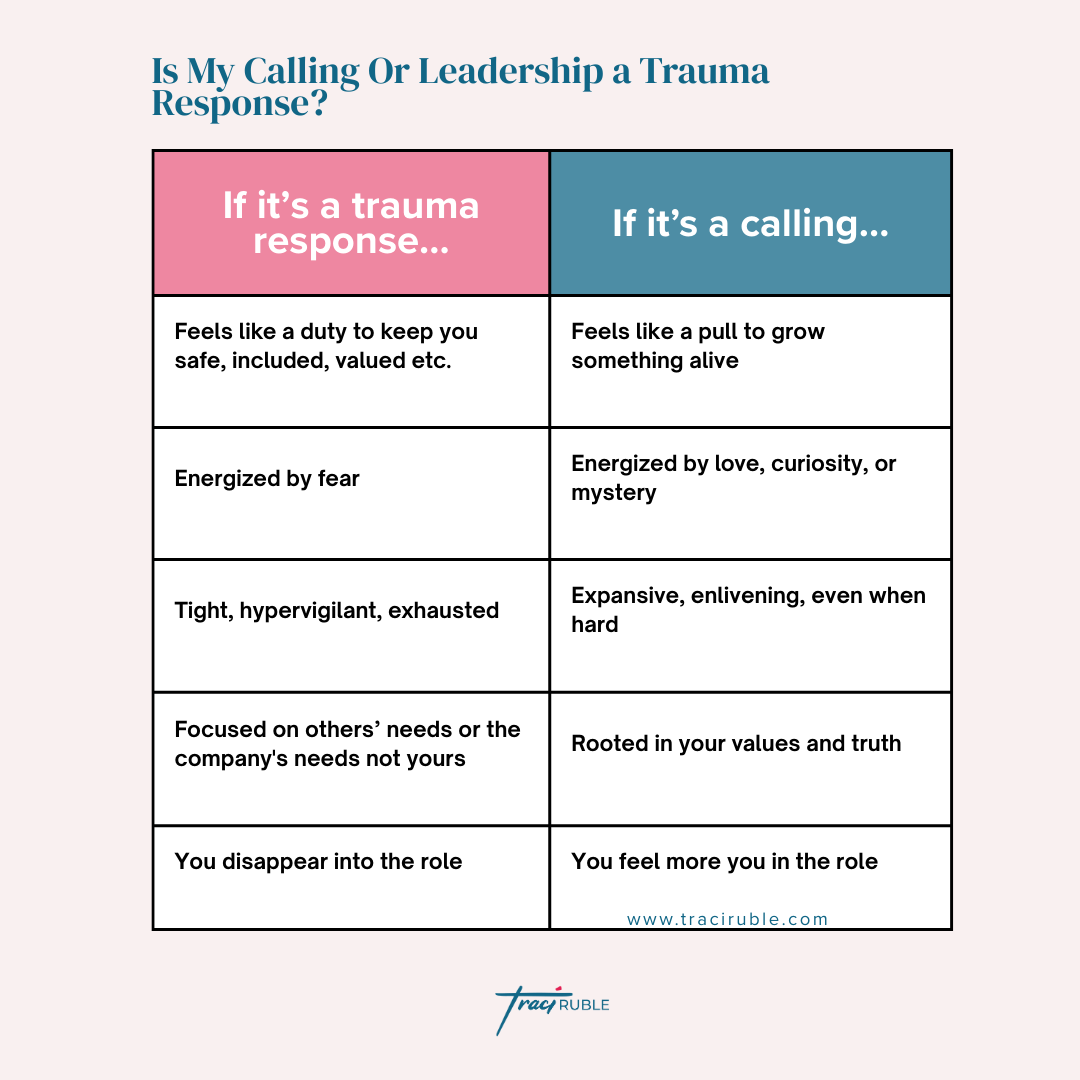
Is my calling trauma-based?
The “unwanted” wound I opened this article with is a big one but it’s not the only one. Many of us chase being needed as a way to unconsciously cope with hidden hurts or beliefs about ourselves that formed in early relational or systemic traumas. Here is a great piece from FORBES on why leaders should take the time to work on their own trauma.
Here are a few:
The "Unseen" Wound
“I was never truly witnessed, so now I need to matter visibly.”
If your presence was tolerated but not fully mirrored as a child, you might have learned to make yourself seen through achievement. Maybe you became the star student, the tireless worker, the one who could always be counted on. You weren’t recognized just for existing—you were rewarded when you produced, fixed, or performed. And so, service or leadership became a way not just to contribute, but to exist in the room. That chase for visibility can look virtuous on the outside but be rooted in an ache to finally feel real, worthy, and reflected.
The "Unsafe" Wound
“The world is dangerous, so I need to stay essential to survive.”
When your nervous system was wired for chaos or inconsistency, being needed becomes a shield against rejection or abandonment. You may have grown up in a home where no one knew how to soothe each other, where love was sporadic, and connection came through crisis. In that kind of environment, you learn to anticipate others’ moods, to fix things quickly, to be indispensable. I once worked with a leader who ran an incredibly successful nonprofit. She was brilliant but she confessed that her obsession with "keeping everyone safe and stable" came from a childhood of being the emotional anchor in a volatile household. Her leadership wasn’t fake but it was overextended, because she was still trying to protect everyone from a storm that already passed. (Yes I altered the story for identity protection ya'all)
The “Not Enough” Wound
“If I give more, I’ll finally be good.”
Service becomes a performance of redemption. If you’re always overgiving, you might be unconsciously trying to outrun a core belief that you’re not inherently worthy. I’ve worked with many high-achieving leaders who give and give, convinced they’ll finally feel peace when everyone else is taken care of. One founder I supported ran herself into the ground building a “conscious” company, and still couldn’t sit with praise. She always felt like she owed someone more. Underneath was a childhood shaped by emotional withdrawal and the silent belief: I have to earn my right to be here. Overgiving wasn’t generosity it was penance. Another word for this one is the "savior complex".
The “Voice Doesn’t Matter” Wound
“I’m not allowed to take up space with my own needs, so I’ll only speak when I’m helping others.”
You become everyone’s conscience, advocate, and cheerleader but can’t say what you really want. I once supported a founder who could champion her team, uplift a cause, and advocate for anyone’s voice but her own. When it came to sharing her own needs or saying no, she froze. Her childhood taught her that speaking for herself wasn’t emotionally safe but speaking for others was noble. Her leadership voice was strong. Her personal voice? Nearly silent. The journey wasn’t about removing her leadership it was about inviting her into it fully. I resonate with this story in many ways.
The “Overfunctioning as Loyalty” Wound
“If I stop doing everything, I’ll betray who or where I came from.”
Sometimes the drive to overfunction isn’t about fear or ego it’s about loyalty to origin. To family, culture, community, or the younger version of yourself who fought to be safe. You might stay in roles, responsibilities, or survival patterns because letting go feels like abandoning the past or the people who made you. One man I worked with had spent 15 years leading a grassroots organization without a single vacation. His work ethic was ferocious. It wasn’t about recognition or growth it was about honoring his brown-skinned immigrant father, who worked three jobs to keep the family afloat after immigrating tot the states and meeting racist roadblocks at every turn. Slowing down felt like betrayal to his dad and his culture. His overfunctioning wasn’t about ego it was a devotion to lineage and we decided it was worth exploring so he was able to give more consciously to his lineage. I also see this in couples a lot too. I will over function in the family with my partner and kids with the same monkey on my back from my personal history. And it shows up in my office like resentment at the partner.
The "Control Through Service" Wound
“If I’m the one everyone needs, I can’t be left.”
Sometimes being needed is a form of control if others rely on you, they won’t abandon you. I remember a longtime volunteer at an organization I was affiliated with who always positioned himself as the one with the answers , the fixer, the mentor, the backbone. He'd show up early, organize, do extra work we didn't like doing, check on everyone else and put his very health and even financial well-being at risk. He got really really sick but didn't tell anyone. But underneath that posture was a deep fear of being irrelevant that came from his his experience as an immigrant to this country. If he wasn’t holding it all together, who would he be? His need to be needed kept him from intimacy, from collaboration, from rest. Being indispensable had become a cage, even inside a mission he loved.

So… How Do You Know Which Voice Is Talking?
I am wrestling with this question a lot personally and this is what my training has helped me come up with. I put some thoughts of mine below. I was turned on to this faith-based leader in Canada, who wrote a trauma-informed guide to exploring your purpose, which I quite liked.
1. Slow down and track What Happens After the Decision
Do you feel energized or collapsed?
Do you feel like you betrayed yourself… or returned to yourself?
💬 Calling says: “This might be hard, but it feels like me.”
💬 Trauma says: “If I don’t do this, I’ll disappear or be nothing.”
2. Check for Speed & Panic
Calling has an even pace.
Trauma has speed and urgency.
If your inner voice sounds like:
“If I don’t help them, I’ll lose my worth.”
“If I don’t do this now, someone will be mad.”
…it’s probably a defense system talking.
3. Use the Body as a Compass
Somatically:
Defense = chest tight, breath short, shoulders up
Calling = breath returns, creativity flows, time loosens
Ask:
“When I imagine saying yes to this, does my breath come back—or go away?”
4. Let Your Personal Values Filter the Choice
Your values act as a tuning fork when the inner voices sound too similar.
Ask:
Is this choice aligned with how I want to live?
Does this reflect my values or just my fear of not being valuable?
Calling aligns with your values, even when it’s uncomfortable. (Side note: I continue to be amazed how many people have not sat down and made an inventory of their top core values that drive their life.)
Trauma asks you to abandon them in the name of safety or approval.
5. Name All the Voices
Try writing or saying:
“I want to hear from the part of me who wants to be needed.”
“Then the part who’s terrified of being unwanted.”
“Then the part who wants to create, disrupt, play.”
“And finally, from the wise self who sees them all.”
Often, the truth is in the conversation between parts—not the first loud voice that shows up. I have an article on IFS and creating a map of your parts here on this site that could be of value if you like this way of playing.
Sometimes Trauma Sharpens Our Leadership
Sometimes trauma doesn’t just distort our sense of purpose it shapes it. I do not want to shame trauma. Some of my traumas have made me more able to serve. It is knowing the difference that is key. There are people whose callings emerge from their pain, not in spite of it. If you were unwanted, overlooked, or cast outside the circle, you may now have a precise eye for inclusion, connection, or justice. Your trauma didn’t create your gifts but it sharpened them.
I was unwanted. I was a perpetual outsider. And now I observe human connection with a fine-toothed comb. My insight didn’t come from nowhere. It was shaped refined by pain.
But here’s the bit I have been asking myself:
Are you letting your trauma sharpen your calling… or are you letting it use your calling as a shield?
This is the heart of discernment that I have to slow way down every damn day and gut check with myself. Your story can inform your gifts, but it doesn’t have to run the show.
Using Play and Compassion To Explore Your Leadership
You don’t need to find a perfect litmus test for your inner voice, so go easy on yourself when you read this. This is an invitation, and I am right here with you, plodding alongside you, getting curious about myself too.
Instead, build trust like this:
Listen.
Choose something small.
Watch what happens.
Adjust without shame.
Repeat.
You’re not failing if you discover you’ve been leading from a defense.
You’re becoming wise.
Some Journal Questions To Explore “Is It Calling or Trauma?”
What’s something I’ve said yes to recently that left me feeling tight or resentful? What value of mine wasn’t honored there?
What would it look like to make the same choice but rooted in love, not fear?
What parts of my leadership feel like a natural expression of who I am, and what parts feel like I’m performing a role I can’t step out of?
If I stepped away from this role or identity tomorrow, what part of me would feel relieved? What part would panic?
When I imagine being irrelevant or not needed, what feelings or memories show up in my body? What do those parts of me need?
Who (or what) am I being loyal to by overfunctioning? Is that loyalty still serving the life I want to live now?
What would leadership rooted in my values but free from my survival story feel like in my body, my time, and my voice?
I hope you took in this piece with kindness and gentleness toward yourself. It’s so easy to go on autopilot in our work and service. But here’s one thing I know: just because something makes you money or earns public praise doesn’t mean it’s the right thing for your soul. And that rushy, fast energy? It’s not always a spark. It can be the electrocution of trauma.
I believe we can work with our trauma rather than be driven by it. That excites me. Because when more of us create ripple effects in the world from a deeper place of care and consciousness, the whole world shifts.
That said, change like this is slow. It requires the trust that we can let go of old patterns of protection and still be okay. So I hope you’ll join me in approaching this exploration with grace and kindness toward yourself. You deserve that.
A few other helpful articles on this topic:
What Makes Entrepreneurs Burn Out , Harvard Business Review
From Emotional Triggers to Values‑Based Leadership, Harvard Business Review
Overcoming the Effects of Childhood Trauma in the Workplace, Psychology Today
Big love to you.
Traci