
Schema Therapy for Couples: Why You Keep Having the Same Fight
Traci Ruble, LMFT 51082 | traciruble.com | Heidelberg, Germany
“What if you are not in fact having the same fight over and over again? What if you’re replaying emotional patterns that were written long before you met one another? ”
I have been doing couples therapy for over twenty-three years, probably still making sense of the six marriages among my parents. I have also been married twenty-two years and sheesh it is work. I genuinely want to make your journey of partnering one that maybe doesn't feel good at every moment (because that, my friends, is not possible) but that is meaningful, really alive, and growthful. I also have a side curiosity reading about the history of marriage and nuclear family. Stephanie Coontz has a new book out called For Better and Worse: The Complicated Past and Challenging Future of Marriage. I am interested in other things too, like how the outside world (politics, climate change, return-on-investment capitalism) also shapes our relationships, but that is an article for another time.
My couples clinical home has been The Couples Institute and its Developmental Model. Gestalt therapy was where I started in my individual training 27 years ago, but I quickly moved to psychodynamic and somatic work as well. All along the way, The Couples Institute turned me on to the Gottmans' research on what makes relationships last, Terry Real's Relational Life Therapy, Emotionally Focused Therapy, and Stan Tatkin's PACT work. I am not a one-model "this is the only way to do couples therapy" person. So pop into trainings and learn and pop out.
But, I gotta say I am genuinely excited about schema therapy for couples, and that means a lot coming from me because I have been so model agnostic. I told pals, that this is it. I am getting certified in this one. Why? Roughly 30% of couples come in with material that will not be solved by better behavior or communication skills. They need to learn how they were shaped, how their nervous system gets triggered, and how their partner's nervous system gets triggered. Schema therapy gives couples therapists a foundation to stay steady and effective with exactly these cases.
I am in the early stages of this training. It will take at least two more years before I consider myself fully grounded in it. But I am writing this piece anyway, for two reasons. First, being able to describe a model clearly is part of how I learn it. Second, I want the couples who need schema therapy to read this and arrive already holding some of this language, so I will probably send a lot of clients this article as prep for our work together.
Schema therapy is for high-conflict, high-trauma, or really stuck couples that need empathy but also a lot of leadership and action by the therapist. Concrete enough to give couples nonjudgmental explanations. Deep enough to get to the core of their patterns without skimming over them with just a bunch of skills the couples are unlikely to use. And organized enough that even a flooded nervous system can feel helped. There is a lot of psychoeducation and detailed language for couples' patterns, and an action plan so they genuinely feel like they are moving the ball down the yard line (sorry, non-US folks, that is a football metaphor). I was worried folks would feel diagnosed, but it turns out people actually feel understood when you can label with empathy what their defenses and interaction patterns are (schemas and coping modes).
The Still Face Experiment: What Infant Research Tells Us About Couples
Before I give the nuts and bolts about schema therapy, I want to tell you about an experiment from developmental psychology. It is called the Still Face Experiment, worth your time if you are in a committed partnership. Because partners do the same dance, this mother and the baby do, but with the baggage of their schemas and modes.
A mother and her baby are playing. Connected, delighted, in full attunement. The baby is lit up. But then the mother goes still. Blank face, no response, no warmth. She is there but not there. The baby tries everything. Points. Reaches. Smiles harder. Vocalizes. Tries every trick in the developmental repertoire to get the person back. When nothing works, the baby emotionally collapses inward. Goes quiet. Starts to show signs of real distress. Then the mother returns to warmth. And after a moment of hesitation, the baby comes back too. This was designed to study infant development. But when I show it to couples, they get something. Because almost everyone in a struggling relationship has been both mother and baby in that experiment. The one going blank. The one reaching harder and harder for a response that does not come. The hesitation coming back together. We are still that baby. Under enough stress, in our closest relationships, we return to the most fundamental question of our nervous system: are you there? Are we safe? Will you stay? The fights that couples keep having are not really about the dishes or the plans or the tone of voice. They are two nervous systems asking very old questions and not finding the answers they need. Schema therapy for couples gets at those moments that hurt so much where one partner inadvertently turns away emotionally or physically and the other partner either shuts down or reaches harder
Why We Are The Most Defensive Or Awful With the People We Love Most?
Here is something I say often to couples: we are more defended, more reactive, and more psychologically raw in our romantic partnerships than in almost any other relationship in our lives. This is not a character flaw. It is structural. Romantic partnership touches the most fundamental human needs, including the core unmet ones from our earliest relationships, which means it also activates our most primitive (read immature or icky) defenses. (I wrote a piece of scorekeeping, for example that gets a lot of attention here.) The patterns that stay mostly underground at work, with friends, even with family, come fully alive when we feel threatened by the person we depend on the most, our partner. A lot of therapy models handle this reasonably well for couples in the mild to moderate range. What I appreciate about schema therapy is that it was built to work with the hardest patterns, including the most defended, least flexible, most entrenched ways of being in relationship. Its founders are not celebrities. It is not in vogue. But the research base is substantial, and it was designed specifically to reach the places that other approaches cannot always touch.
What Is a Schema? The Childhood Wounds That Shape Your Adult Relating Patterns Now
A schema is a deep, core belief and felt sense about yourself and about how relationships work, formed from past experience. It develops early, usually in childhood, when some important need kept going unmet. And once the schema forms, it becomes the lens through which you read everything that happens in your closest relationships. Schemas are not conscious. You do not walk around thinking "I have an abandonment schema." You just feel a particular alarm when your partner is quiet. You just have this felt knowing in your body or brain that something painful is going to happen. Some overlap exists between Schema Therapy and Internal Family Systems. You can read my use of IFS for couples here.
Some of the most common ones in couples work:
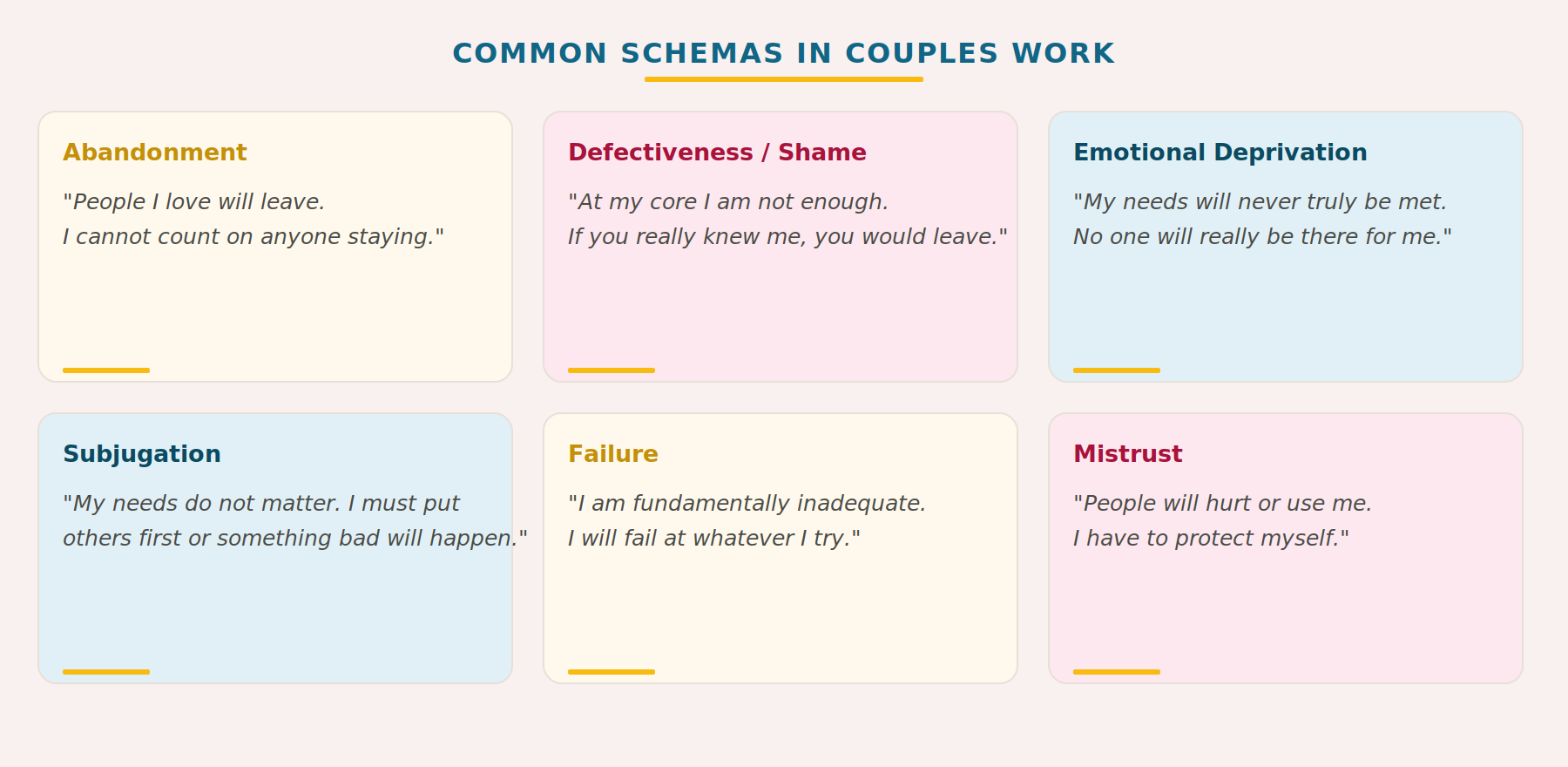
Scroll down for a FREE Html Tool I made where you can see a detailed list of schemas and their correspondin coping modes (defense mechanisms) you can start identifying in yourself.
Reminder: schemas are not flaws. They are a bit ingenious. They are conclusions a child drew from the evidence available to them. They were accurate then. The problem is that they persist long past their usefulness, and they are self-perpetuating. We keep acting in ways that get the outside world to confirm the schema all over again. And then we fall in love. And discover that our schemas and our partner's schemas fit together in ways that felt like chemistry at first and feel like shit later.
The Three Core Needs Underneath Every Relationship Conflict
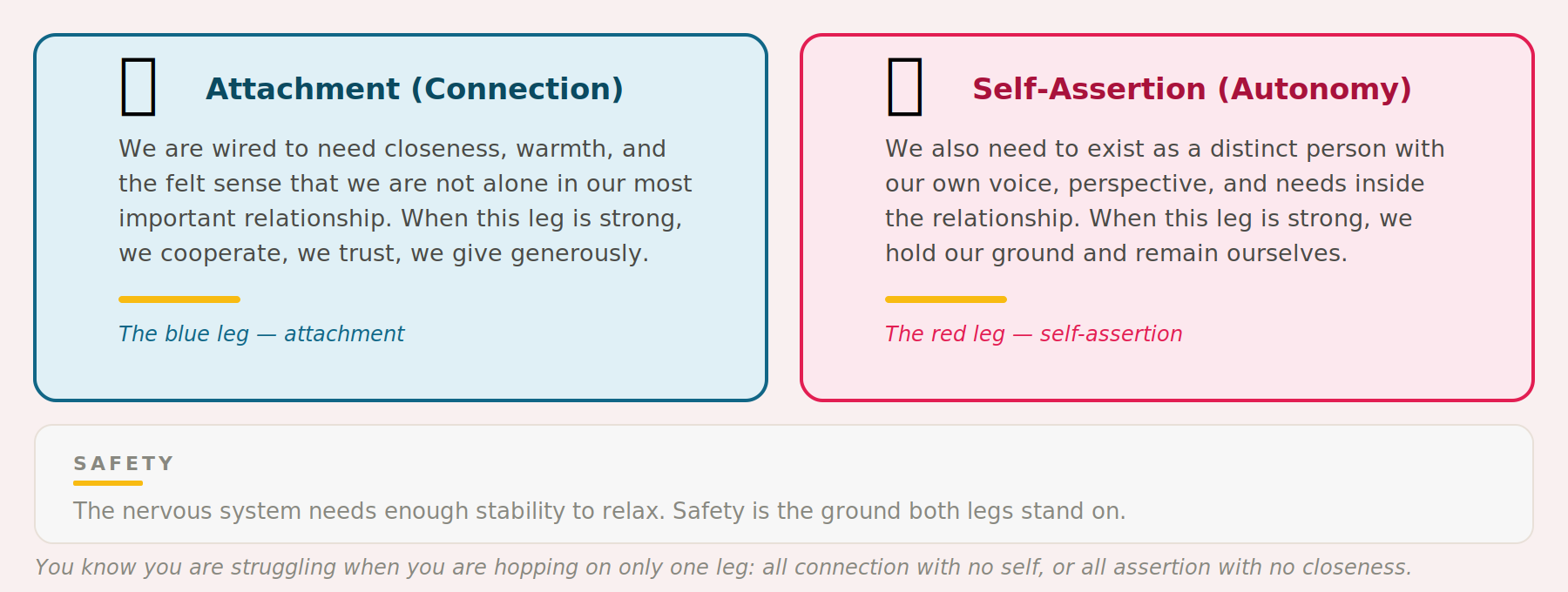
Beneath all the complexity of relationship conflict, there are three basic needs. When they are being met, we are okay. When they are not, everything gets hard fast.
The model uses the image of two legs for a reason. When both legs are healthy and roughly balanced, we can move through relationship with some flexibility. When one leg is much stronger than the other, we stumble. And the person across from us usually is stronger on the leg we are weak on, which is part of what drew you together in the first place. If you are good at assertion, your partner likely is better at connection.
How the Coping Mode Clash Cycle Works in Couples
When a schema activates, something changes neurologically before it changes psychologically. The nervous system reads threat. The older, faster parts of the brain take over. The capacity for curiosity, nuance, and generosity shrinks fast. And then we cope. Each of us has learned ways to manage when we feel threatened by the person we love. Schema therapy calls these coping modes.
For working with couples we often simplify them into three coping modes (couples I see, commit these ones to memory cuz we will talk about them a lot):
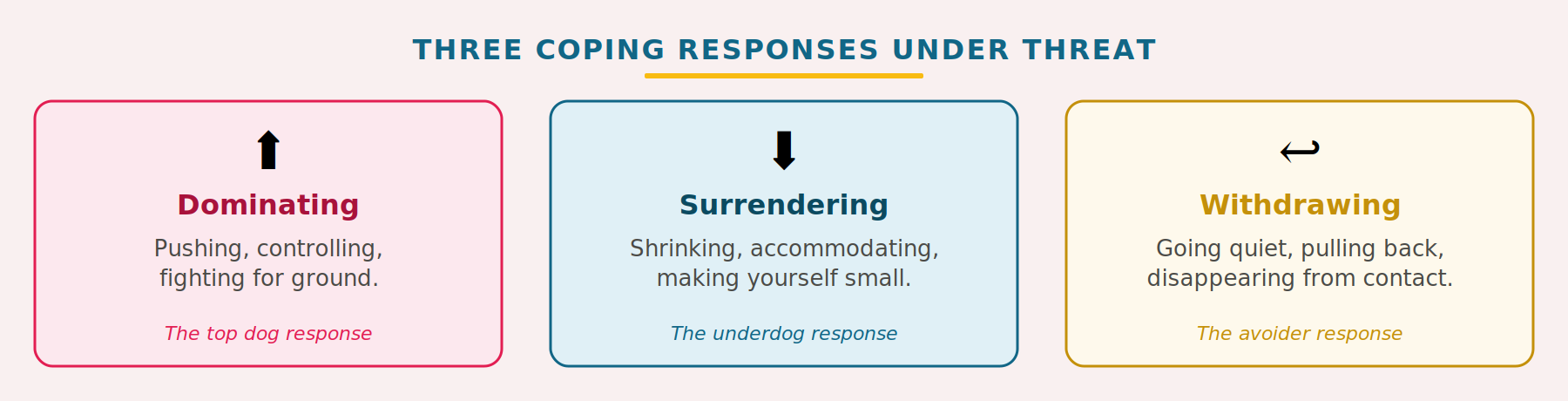
Keep in mind, none of these is a choice in the heat of the moment. They are automatic. They are what you learned works before the age of ten, usually. Here is how the cycle plays out between partners. One person's trigger activates an old wound, which fires a feeling, which kicks up a protective coping mode, which leads to a coping response: dominating, surrendering, or withdrawing. That coping response lands on their partner and activates their old wound, their feeling, their protective mode, their coping response. I wrote a piece about withdrawing or emotionally unavailable partners here if that would be helpful.
The result is that both people's core needs go unmet, and the loop closes. Neither person is choosing this. Both are doing exactly what they learned to do. This is why good communication skills won't work here. You have to understand your coping modes, grow the capacity to step back from them slowly, and start choosing different behavior when those very young and very painful unmet needs get stirred up.
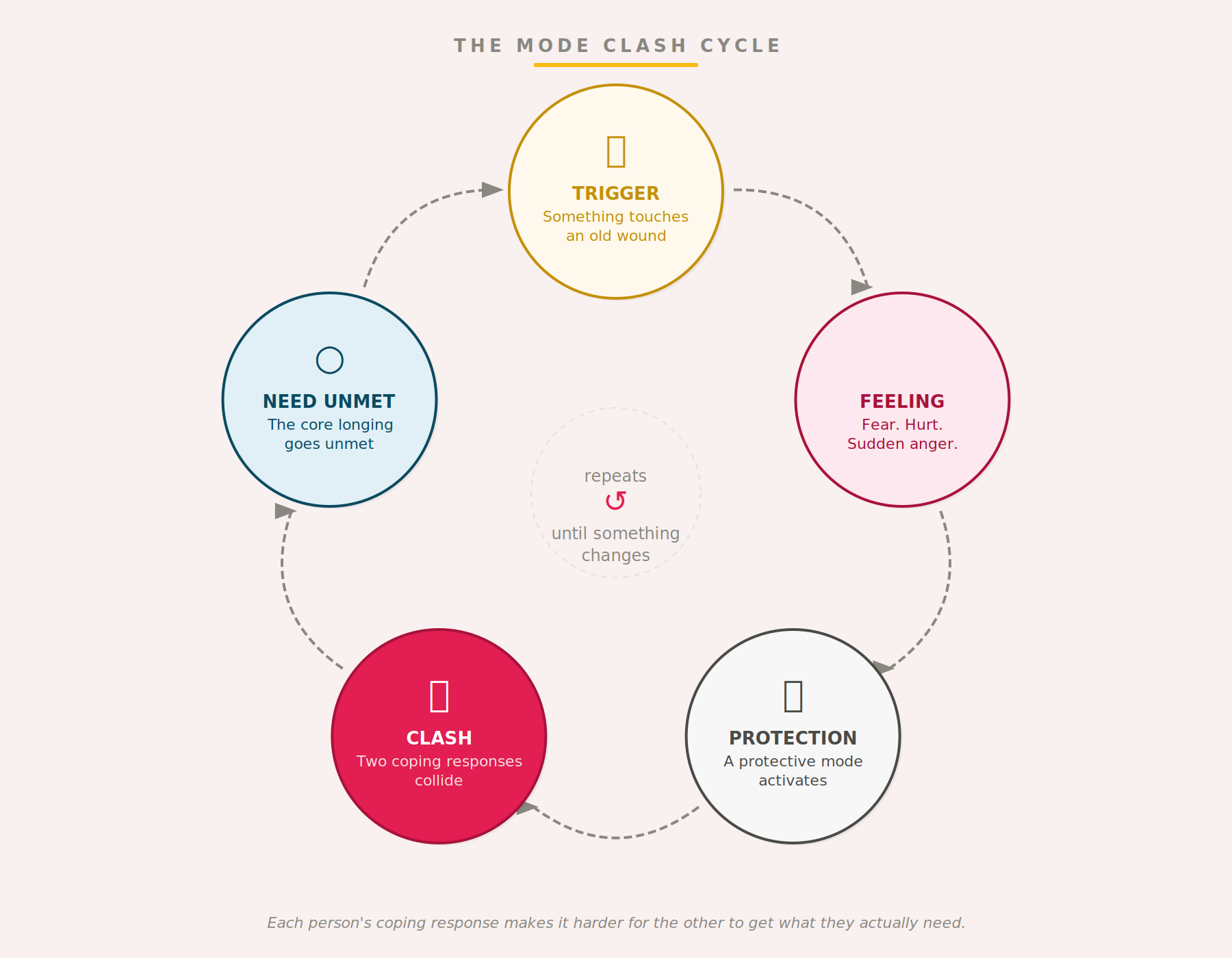
This is the cycle of clashing modes. Not a communication problem.
Not a compatibility problem.
Two nervous systems, each doing exactly what they learned to do, making it nearly impossible for the other to meet that core need they are most longing for.
What Schema Therapy for Couples Actually Looks Like
When you come to work with me using this framework, I am not there to referee your fights. I am not the moral police, weighing who said what and assigning fault. I am not interested in making one of you right and the other wrong. I am not eagerly waiting to tell you this is a bad marriage that you should leave. Nor am I diagnosing you with personality disorders. I care about both of you. And I care about the core needs underneath this painful conflict, the tender needs of yours that you have been trying to get met for years, possibly decades. But here is what I will help you start to see: the strategies you are using to get your needs met are the problem, not your partner. The work is to help you build an observing part of yourself that can watch the faulty strategies you are using the relating pattern it creates while you are inside it. Your partner, too. Not perfectly. Not every time. But enough for you each to make a different choice sometimes in this awful fights. To recognize the cycle before it has fully sparked off. To reach toward your own unmet need, and your partner's, with a little more care and a little less armor. Slowly, you learn to walk on balanced legs. To stay connected to your partner without losing yourself, and to hold your own ground without losing each other.
How Schema Therapy Integrates With IFS, STAIR, and Psychodynamic Work
What schema therapy adds to the frameworks I already use in my work is structure and concreteness. My STAIR training runs underneath all of it. Schema work asks a lot of the nervous system, and the regulating, containing work from STAIR is what makes it possible to go to these depths without people leaving the session more dysregulated than they arrived. Doesn't mean you will be comfy. It is hard looking at these patterns, but STAIR helps me balance activation and regulation so your brain and body are in a learning state.
Schema therapy for couples also involves my meeting with each partner individually on a regular basis, not just during conjoint sessions. The deeper individual work with schemas and history is usually better done one-to-one. IFS and psychodynamic thinking are still there. Schema therapy gives us the map and the concrete intervention points. IFS gives us access to the parts underneath. Psychodynamics still informs the unnameable unconscious patterns between all of us in the room, me included. I have made two small language changes to the model for my own practice. What Roediger's Schema Therapy for Couples model calls the "child mode," I call the Protective Mode. What the model calls the "healthy adult," I call the Regulated Self. These are not just semantic choices. The words we use in the room matter. I prefer labels based on function rather than labels that can feel like a value judgment.
Free Interactive Tools for Couples Doing Schema Therapy
I have built three interactive tools to support this work between sessions. They are not therapy. They will not resolve anything on their own. Everything you enter is saved privately on your own device. Nothing is sent to me. These tools belong to you. I do ask for your email not to add you to a list but just to know if these are valuable to you and who is accessing them.
Tool 1: The Schema and Mode Explorer
Start here if you are new to this work. Click on any schema, and you will see the core belief underneath it, the coping style that tends to build around it over time, and the modes that show up in the moment when the schema gets activated. The second tab is a Mode Tracker for logging what happened after you got reactive.
Tool 2: The Mode Cycle Clashcard
Use this one after a conflict. The clashcard walks through the cycle for each partner. The most important field is the clash in the middle: when you select both partners' coping responses, the card describes what that collision tends to produce and why it keeps both people from getting what they need.
Tool 3: The Mentalizing Check-in
Mentalizing is the capacity to stay genuinely curious about what is happening inside your partner rather than certain you already know. This tool has three tabs: a plain language explainer, a self-assessment built around a specific recent conflict, and a weekly pulse to rate how your mentalizing has been.
Frequently Asked Questions
What is schema therapy for couples?
Schema therapy for couples is an evidence-based approach that helps partners understand the deep beliefs and coping patterns driving their conflict. Developed by Eckhard Roediger and Bruce Stevens, building on Jeffrey Young's foundational schema therapy work, it gives couples a shared map for why the same fight keeps happening and concrete ways to interrupt the cycle.
What is a schema in relationships?
A schema is a deep, core belief about yourself and how relationships work, formed early in life when important needs went unmet. Common schemas in couples work include abandonment, defectiveness and shame, emotional deprivation, and subjugation. Schemas are not conscious. They run in the background, interpreting everything, often without you knowing they are there.
What is the Still Face experiment and what does it show us about couples?
The Still Face experiment, developed by developmental psychologist Edward Tronick, shows what happens when a mother goes suddenly blank and unresponsive with her baby: the baby tries everything to re-engage her, then collapses in distress. When I show this to couples, most recognize it immediately, not from childhood but from their relationship. It illustrates how fundamental our need for connection is, and how quickly we return to the most primitive question of our nervous system when we feel threatened by the person we love most.
What is the mode clash cycle in couples therapy?
The mode clash cycle describes what happens when two partners' coping responses collide. One person's trigger activates an old wound, which fires a feeling, which kicks up a protective mode, which leads to a coping response of dominating, surrendering, or withdrawing. Their partner's coping response meets that and activates its own cycle. The result is that both people's core needs go unmet, and the loop closes. Neither person is choosing this. Both are doing exactly what they learned to do.
How is schema therapy different from Gottman or EFT?
Gottman's approach is research-based and focuses on the behavioral patterns that predict relationship success or failure. EFT focuses on attachment patterns and helping partners access and express vulnerable emotions to create new bonding experiences. Schema therapy adds a deeper map of where each person's patterns come from, the specific childhood schemas and coping styles driving the cycle, and then works directly with those through both cognitive and experiential interventions. I use all three in my work, alongside IFS, STAIR, and psychodynamic approaches.
Is schema therapy good for high-conflict couples?
Schema therapy for couples draws on one of the more research-supported individual therapy models in the field, particularly for complex and entrenched presentations. The couple’s adaptation is newer and still building its evidence base, but the underlying framework was built to reach the kind of defended, chronic patterns that better-known approaches often don't have as much success with. That is part of what drew me to it for high-conflict work so I had some stronger sea legs with these couples so I can be effective and they get what they need.
How long does schema therapy for couples take?
Schema therapy for couples is not a short-term model. It also isn’t a model I need to use with all couples. Tracing schemas to their origins, reworking entrenched coping patterns, building the capacity for each partner to meet their own and the other's core needs, sorry folks, as you guessed it, takes time. I typically work with couples for at least one to two years with these kinds of difficult patterns, with individual sessions woven in alongside the conjoint work. That said, couples often notice meaningful shifts relatively early, because having a shared map and vocabulary for what is happening changes the dynamic even before the deeper work is complete.
Do you offer online couples therapy?
Yes. I work with couples internationally via secure video. My practice is based in Heidelberg, Germany, and I hold a California LMFT license. I work with all kinds of couples, executives, founders, and diplomats who are looking for a rigorous, depth-oriented and effective approach to their relationship.
What are the free tools mentioned in this article?
I have built three interactive tools for couples doing schema therapy work with me: the Schema and Mode Explorer, the Mode Cycle Clashcard, and the Mentalizing Check-in. All three are free, save privately to your own device, and are designed to build self-awareness between sessions rather than replace therapy. Links to each tool are embedded throughout this article.

About the Author: Traci Ruble, LMFT 51082, has been sitting with couples, individuals, and families for over twenty years. She is a California-licensed Marriage and Family Therapist practicing internationally via secure video from Heidelberg, Germany. Her couples work draws largely from the Couples Institute Developmental Model, Gottman's research, Terry Real's Relational Life Therapy, Emotionally Focused Therapy, Internal Family Systems, STAIR, and psychodynamic approaches, with schema therapy for couples as her most recent addition. You can read more about Traci’s training here. Traci works primarily with couples, executives, founders, and diplomats who are looking for depth, rigor, and honesty in their clinical work. She is also the founder of Sidewalk Talk, a global community listening project that has trained over 10,000 volunteers to offer free listening in public spaces across 120 cities and 20 countries. She writes about relationships, repair, and what it actually means to stay curious about the person across from you. Learn more or inquire about working together at traciruble.com.